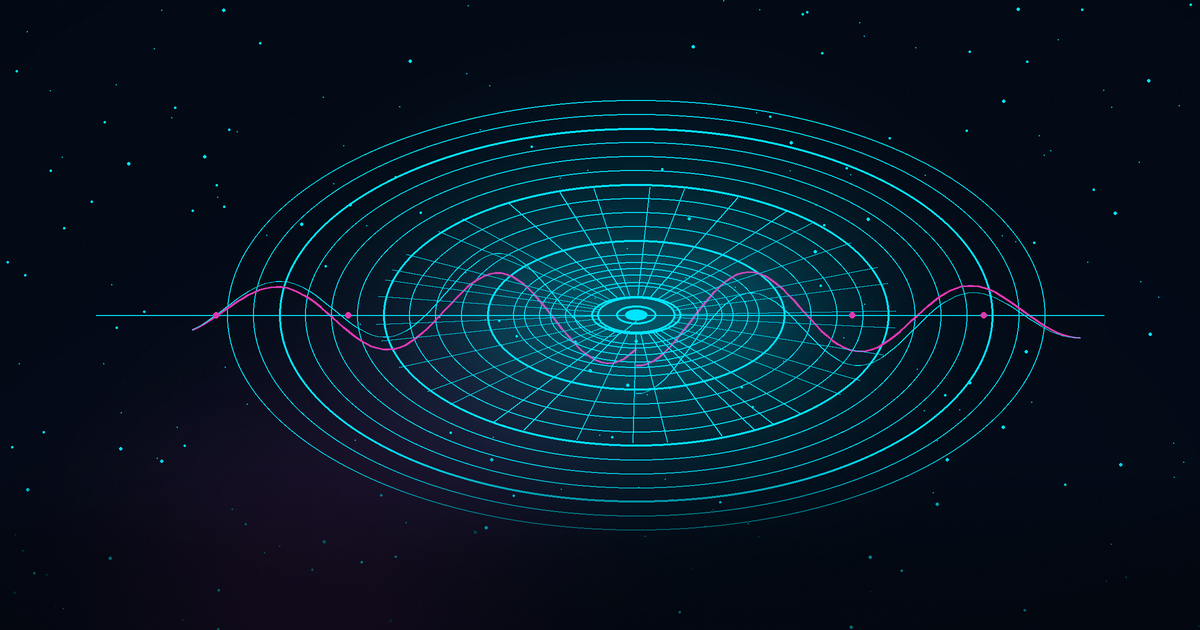
Walter Russell's The Universal One is not a lost physics textbook. It is an artist's attempt to make spiritual monism measurable-looking: a cosmology of light, wave rhythm, and universal return that reveals how diagrams give metaphysics the authority of science.
Some books announce themselves as arguments. Walter Russell's The Universal One announces itself as an instrument panel. Its title page promises “an exact science” of the visible and invisible universe; its pages move from God and Mind to electricity, the elements, gravitation, dimensions, tone, color, and the wave. Between those poles are charts: arcs, octaves, pressures, spirals, and tables meant to make the invisible legible.
The result is easy to misread in two opposite ways. It can be treated as a secret twentieth-century physics textbook that orthodox science somehow ignored. Or it can be dismissed as decorative mysticism wearing a laboratory coat. Both reactions miss the book's most revealing achievement.
The Universal One is a visual cosmology: an artist's attempt to give spiritual monism the outward grammar of measurement. Russell does not merely say that all things are one. He tries to make oneness behave like a diagram: divided into opposing pressures, unfolded through rhythmic cycles, condensed into matter, and returned to equilibrium. The lasting value of the work is therefore not that it replaces the Standard Model or supplies a forgotten periodic table. It is that it exposes a recurring human operation: when metaphysics borrows the shapes of science, the diagram becomes part of the proof.
This is the same transmission in two editorial dialects: the Vault of Arcana source-archive study and this Universal Transmissions companion scroll. The two pages are one corridor with two kinds of light: here the emphasis is on the geometry of perception; the Vault version keeps the emphasis on provenance, symbols, and the limits of the claim.
Reading note: This essay was checked against the Codex corpus copy indexed as THE_UNIVERSAL_ONE.pdf and against the Internet Archive scan of the 1926 Russell volume. Page references follow the scan's printed pagination. Russell's claims are reported as claims; they are not presented as established physics.
The Artist Before the Cosmologist
The first key to Russell is not a formula. It is his eye.
The University of Science and Philosophy biography describes a life that crossed illustration, portraiture, sculpture, architecture, philosophy, and education. Russell was born in Boston in 1871, left school at nine, studied art in Boston and Paris, and later made portraits of figures including Mark Twain, Theodore Roosevelt, and Thomas Edison. The same institutional account identifies the Hotel des Artistes as one of his architectural landmarks and places the turning point of his life in 1921, when he reported a thirty-nine-day “illumination.”
That last word needs a boundary around it. The illumination is Russell's account of his experience, not an independently verified observation of the universe. But it tells us how the book should be read. He did not begin with a physics laboratory and arrive at a spiritual conclusion. He began with an artist's conviction that form, proportion, rhythm, and balance disclose something real, then sought a universal language capable of carrying that conviction into science.
This makes the book's title unusually precise. The One is not only a theological unity. It is a compositional problem. How can a single substance appear as many substances without ceasing to be one? How can stillness appear as motion, and motion return to stillness? How can an invisible cause be registered in visible form? These are questions a sculptor understands bodily. A block is one material, yet it can disclose many forms. A figure appears still, yet its posture is a balance of tensions. A building is stable because forces have been arranged, not because force has vanished.
Russell transfers that intuition to the cosmos. The universe becomes a work whose forms are temporary registrations of a deeper rhythm. The image is powerful even when the physics is not.
The bibliographic history matters too. The scan carries a 1926 copyright notice, while its preface says the work was originally published in 1927. The Open Library record describes the available edition as the 1974 University of Science and Philosophy publication and notes that Russell later revised some details in The Secret of Light and A New Concept of the Universe. That admission is useful: even the tradition's own catalog warns readers not to treat every version as fixed revelation.
A Universe Made From One Substance
Russell's first move is theological, but he immediately gives it physical consequences. In the opening chapter he writes, “There is but one universe. God is the universe,” rejecting a separate perfect realm that manufactures an imperfect material one. The claim appears on the printed pages as a metaphysical proposition, yet the rest of the volume tries to turn it into a mechanics.
The book calls the one substance Mind. Mind is not merely private thought or a stream of ideas inside a skull. It is the universal substance from which all appearance is registered. On the early pages Russell says that thinking is the cause of motion and that the periodicities caused by thinking Mind are registered in light, which he identifies with matter and energy. His famous compression is blunt: “Matter is light.”[1, pp. 7–8, 26–27]
Read literally, that sentence is misleading. In contemporary physics, “light” can mean electromagnetic radiation, while matter refers to physical systems described through particles and fields. Russell is using the word in a much wider metaphysical sense: light is the universal medium in which thought becomes appearance. The sentence is less a measurement than a bridge between ontology and image.
That bridge has an internal logic. If there is only one substance, then difference must arise through state rather than through separate ingredients. The elements do not differ because reality is made of fundamentally unrelated stuff; they differ because one substance occupies different conditions of motion. Russell's cosmology is therefore a theory of difference without division. Form is real as an appearance, but not ultimate as substance.
This is where the book touches the history of sacred geometry. A circle can be divided into radii, sectors, and harmonics without becoming less circular. A vibration can generate a pattern without creating a second material. A single field can produce many figures when its conditions change. Russell's diagrams function as a visual promise that multiplicity can be explained by transformation alone.
The promise is philosophically old. The presentation is distinctly modern: use the language of spectrum, voltage, mass, dimensions, and periodicity, then let the reader feel that the old One has acquired a meter.
Opposites Are the Engine of Appearance
On page 21 of the scan Russell states a principle that governs the book's entire architecture: “All motion is motion in equilibrium. No other motion is possible.” He then divides appearance into two poles, naming them “motion-in-inertia” and “motion-in-opposition.” Matter, in this vocabulary, is motion-in-opposition: a condition in which unequal pressures are sustained by resistance. Inertia is the balanced condition toward which the opposition returns.[1, pp. 21–24]
This is not the same as the modern technical meaning of inertia, and it should not be quietly substituted for it. Russell is building a symbolic mechanics. The universe breathes, contracts, expands, charges, discharges, evolves, and devolves. Creation is not a one-time event but a rhythm of polarization and return.
The vocabulary of opposition also explains why Russell's charts are so symmetrical. A line running outward from a center can represent radiation; the return line can represent contraction. An octave can be read forward as increasing density and backward as dissolution. A pair of opposite cones can become a wave. The diagram does not illustrate a process after the fact. It is the process in visible form.
At its most coherent, the model resembles a metaphysical grammar:
- One substance supplies continuity.
- Opposition supplies difference.
- Rhythm supplies sequence.
- Equilibrium supplies return.
- Form supplies the temporary record of the cycle.
This is why Russell can move without embarrassment between atom, planet, human being, and God. He believes the same law operates at every scale. The analogy is the point. A sodium atom, a human body, and a planet are not identical objects; they are different registrations of one universal action and reaction.
The danger is that the same analogy can flatten real distinctions. A metaphor that is fertile in art can become false when presented as a quantitative identity. The reader has to hold both facts at once: Russell's polarity gives the book a memorable architecture, but an elegant architecture does not establish that nature obeys it.
The Spectrum as an Alphabet
Russell's most memorable scientific image is his treatment of spectral lines. On page 62 he says that the spectrum has been divided into approximately seven thousand color lines of light and calls them the letters of a universal language. He imagines the spectroscope not as a machine that merely identifies an element, but as a reader that has not yet learned the cosmic sentence encoded in each line.[1, pp. 62–64]
This is a beautiful conversion of instrument into scripture. A spectral line is no longer only a result; it is a character. The laboratory becomes a page, and the universe becomes an author. The move also reveals Russell's priorities. He is less interested in measurement as a narrow procedure than in measurement as a revelation of meaningful order.
The National Institute of Standards and Technology's periodic-table resource offers a useful contrast. NIST presents the elements through standardized names, symbols, atomic numbers, and critically evaluated reference data. Its authority is deliberately impersonal: the table is useful because observations, measurements, and revisions can be compared by other investigators. Russell's chart, by contrast, is an interpretation of what periodicity means within a universal spiritual system.
The two can share a visual vocabulary without sharing an epistemic status. Both classify. Both place items into relationships. Both imply that a hidden order becomes visible when the right arrangement is found. But NIST's table is a public instrument of scientific coordination; Russell's is a metaphysical map that absorbs scientific data into a pre-existing doctrine of Mind, polarity, and return.
That distinction helps us read one of Russell's more extravagant passages responsibly. He says that the lines in helium announce six new elements awaiting discovery and that humanity has not yet learned to read the message. It is tempting to turn this into a prophecy fulfilled by later discoveries. But the book's rhetoric is not a controlled prediction with a dated protocol, error bars, and a condition under which it could fail. It is an interpretive claim inside a total cosmology. Calling it “foreshadowing” may be interesting; calling it experimental confirmation would be too strong.
The spectrum-as-alphabet image still deserves to survive. It teaches a different lesson: instruments never arrive without a culture of interpretation. A device can separate light into lines, but a community decides whether those lines are signatures, data points, letters, or divine speech. Russell makes that interpretive layer impossible to ignore.
The Cosmic Clock and the Ten Octaves
The book's central attempt at formalization appears in the “Formula of the Locked Potentials.” Russell offers the sequence 4 + 3 + 2 + 1 + 0 = 1 - 2 - 3 - 4, describing it as the hours of a cosmic clock. The zero represents inertial energy; the numbers describe progression through locked potentials and pressures. He then connects the formula to a ten-octave cycle of the elements, with mass and tone treated as special cases.[1, pp. 64–66, 125–137]
The formula is not presented as a hypothesis waiting for a statistician. It is a key: a compact shape that supposedly unlocks every dimension of motion. This is a recurring feature of esoteric diagrams. The shorter the expression, the more work it is asked to perform. A circle can mean unity, eternity, orbit, and the self. A number sequence can mean a scale, a moral ascent, a musical octave, and the architecture of matter at once.
What Russell adds is the language of engineering. The locked potential sounds like a mechanism whose states can be calculated. The cosmic clock suggests that the universe is not only meaningful but regular enough to be read. The words “formula,” “dimension,” and “ratio” make the metaphysical pattern feel portable: if the relationship is universal, it should work wherever the reader points the chart.
This is the moment when cosmology becomes diagram. The drawing does not merely simplify an idea; it changes the kind of claim being made. Prose can remain openly speculative. A chart implies that the relations have already been stabilized. It gives the eye a route to follow and lets coherence masquerade as measurement.
That does not make the chart worthless. It makes its value different from the value of a validated physical law. The formula is best read as a symbolic compression algorithm: a way to see Russell's convictions about polarity, periodicity, and return in one glance. Its success is interpretive. Its physical status requires a separate standard.
For readers who want to work with the visual side of these correspondences, the Sacred Geometry Master Collection is a natural archive path—not because a digital pack proves Russell's cosmology, but because studying diagrams side by side makes their grammar visible.
The Pulse: Matter as Breathing Form
In Book II Russell returns to the body-like image of the universe. The chapter titled “The Universal Pulse” begins by describing all motion as oscillatory action and reaction. The One Living Being breathes; mass assimilates and eliminates; the universe alternates between inhalation and exhalation. The inhalative action is associated with electricity, accumulation, attraction, and the generation of form. The exhalative reaction is associated with magnetism, radiation, dissipation, and the disappearance of form.[1, pp. 144–147]
The gendered language belongs to Russell's period and his own system; it should not be mistaken for a neutral description of nature. Its function is structural. “Male” and “female” name the two directions of a cycle, just as charge and discharge, contraction and expansion, and evolution and devolution name paired movements. Russell is trying to make the universe reproductive: every form is born from the union of opposites and returns through their separation.
The image has a clear artistic analogue. A sculpture is not a static lump; it is a negotiation between mass and void, pressure and release, surface and interior. A musical note is not a thing independent of time; it is an event that rises, holds, and fades. Russell's cosmos takes that experience of form and makes it universal. Matter is a held note. A planet is a slow pulse. A body is an octave with a temporary boundary.
The metaphor becomes especially useful when it is kept at the level of perception. It asks us to look at stability as an achievement rather than an essence. A stone appears still because its changes are slower than our senses, not because it has escaped process. A personality appears fixed because repetition has made a pattern familiar. A tradition appears timeless because its cycles have outlasted individual lives.
Russell's physics does not need to be accepted for this insight to work. The pulse is a contemplative instrument. It trains the eye to see forms as events and boundaries as rhythms. That is a legitimate use of a cosmological image, provided the image is not promoted to laboratory evidence without the work required by laboratory evidence.
The Artist's Ethics of Oneness
The book's technical and spiritual halves are not separate departments. Russell's “Law of Love” is described as rhythmic, balanced interchange between all things. The ethics follows from the mechanics: if nothing exists alone, then every form participates in a larger reciprocity. Oneness is not only a statement about what the universe is; it is a demand about how a person should move inside it.
This explains why The Universal One repeatedly shifts from charts to exhortation. The same structure that holds a star together should, in Russell's view, teach a human being how to live. Isolation is a mistaken appearance. Knowledge is not an external possession but a recollection from universal Mind. Creation is not a privilege reserved for a distant deity; humanity is meant to become a conscious co-creator.
There is genuine poetic force in this move, but it also carries a modern hazard. Once the universe is said to be an electromagnetic expression of thought, readers may be tempted to turn the model into a promise that desire directly controls matter, illness, history, or other people. That is not a conclusion established by Russell's charts, and it is not a safe substitute for medicine, evidence, or collective action.
The more durable ethical reading is smaller and harder. If every form is a temporary registration of relation, then attention to consequences becomes part of spiritual intelligence. One does not have to believe that thoughts magnetically manufacture events to recognize that thinking changes what we notice, what we build, and how we treat other bodies. The symbolic law of balanced interchange can become a discipline of reciprocity without pretending to be a causal law of physics.
In this sense Russell's work sits beside the traditions that use geometry as moral pedagogy. A mandala is not only a picture of the cosmos; it is a way of training attention toward center, relation, and return. The Tree of Life is not only a map of emanations; it is a diagram that asks the reader to inhabit a pattern. Russell's innovation is to place the same demand inside the visual language of modern science.
Where the Physics Ends
A responsible reading needs an explicit boundary. The Universal One is not part of the accepted foundation of contemporary physics. The CERN overview of the Standard Model describes a well-tested framework for fundamental particles and three of the four known fundamental forces; it also plainly explains that gravity is not included and that major questions remain. Contemporary science is neither a finished creed nor a blank page waiting for Russell's diagrams. It is a public process of models, experiments, failed predictions, revisions, and negotiated evidence.
Russell's system does not meet that standard merely because it uses scientific nouns. Its “light,” “electricity,” “magnetism,” “dimension,” and “wave” belong to a private synthesis. The synthesis can be internally consistent, historically intriguing, and spiritually meaningful without being empirically confirmed. These categories should not be collapsed:
- Historical truth: Russell really published a large, chart-heavy cosmology in the 1920s, and the book documents one way spiritual and scientific vocabularies were being recombined.
- Symbolic truth: The diagrams can generate useful perceptions about rhythm, polarity, form, and the human desire to find unity in difference.
- Physical truth: A claim about particles, spectra, forces, or the structure of the universe must survive independent measurement and reproducible tests.
The third category is not a hostile footnote. It is what keeps the first two from being exploited. Without the boundary, “all is light” can become a marketing slogan; with it, the phrase can remain what it actually is in Russell's book: a metaphysical compression of the relation between Mind, matter, and appearance.
The Vault of Arcana study of cymatics makes a useful companion here. A vibrating plate genuinely produces visible patterns under specified conditions, but the existence of pattern does not prove that every sacred symbol is a frequency signature. The same discipline applies to Russell: the diagram may be worth studying even when the extrapolation exceeds the evidence.
How to Read the Diagram Without Surrendering Your Judgment
A good reading protocol has three passes.
First pass: provenance. Ask who made the map, when, for what audience, and with what sources. Russell's own account, the 1926 copyright, the 1927 publication statement, and the later 1974 institutional edition are not trivia. They tell us that the book belongs to a particular historical moment and that its tradition has continued to revise and reframe it.
Second pass: grammar. Ignore the promise of final truth for a moment and list the operations the diagram performs. Where does it divide? Where does it mirror? What moves outward? What returns? Which words change meaning when they cross from theology into physics? In Russell's case, the repeated operations are opposition, octave, pressure, spectrum, pulse, and equilibrium. That is the real language of the book.
Third pass: testability. For every sentence that sounds scientific, ask what would count as evidence and what would count against it. “Matter is light” can be a metaphysical statement, but if it is offered as a physical theory it needs definitions, equations, measurements, and predictions that distinguish it from existing theories. “The spectrum is an alphabet” is a potent metaphor, but it does not by itself identify an unknown element.
This protocol does not drain the mystery. It makes the mystery more precise. We can allow a diagram to change how we see without allowing it to exempt itself from the obligations of knowledge. We can let a speculative cosmology become a mirror of its maker—and of our own hunger for a single pattern—without pretending that the mirror is a telescope.
The practice can be simple. Choose one Russellian opposition—charge and discharge, form and dissolution, center and periphery. Draw it in your own terms. Then annotate the drawing in two colors: one for what is directly observed, one for what is inferred or imagined. The gap between those colors is not a failure. It is the place where thought becomes accountable.
The Universal One as a Mirror
The deepest subject of Russell's book may not be the universe. It may be the human wish to discover that the universe is legible in the same way a work of art is legible.
We want the chaos of experience to have a center. We want multiplicity to be a modulation of one substance rather than a collection of unrelated accidents. We want light to be not only something that travels but something that speaks. We want the spectrum, the atom, the body, the planet, and the soul to belong to a common syntax.
Russell gives that desire a spectacular form. His genius is not proved by treating every prediction as fulfilled. It appears in the audacity of the synthesis: theology becomes cosmology; cosmology becomes mechanics; mechanics becomes chart; chart becomes a way of life. The book is a document of an era when “science” could still be imagined as a total language capable of reconciling art, mind, matter, and God.
That total language is not ours. The Standard Model, NIST's reference tables, and the working sciences of spectroscopy and electromagnetism have their own histories and evidentiary rules. But the question Russell dramatizes remains alive: how do the forms we use to organize knowledge shape the reality we are able to perceive?
Read in that light, The Universal One is neither a secret textbook nor a disposable curiosity. It is a machine for noticing the moment when a symbol starts to claim the authority of a measurement. Its charts invite wonder; its claims invite scrutiny. We need both responses.
Questions the Book Still Raises
Is The Universal One accepted science?
No. It is a historical metaphysical cosmology and a speculative “new science” in Russell's own vocabulary, not an accepted replacement for modern physics. Its terms should be read as Russell defines them, then compared—carefully and without false equivalence—with contemporary scientific models.
What does Russell mean by “light”?
He uses light as a universal metaphysical substance and as the visible registration of thinking Mind. That is broader than the modern physical meaning of electromagnetic radiation. The phrase “matter is light” is therefore an ontological claim inside his system, not a standalone experimental result.
Was the book published in 1926 or 1927?
The scanned volume carries a 1926 copyright notice, while its preface says it was originally published in 1927. The University of Science and Philosophy's later edition and the Open Library record identify the work as a 1926 historic volume. The safest description is “the 1926/27 Universal One,” with the edition stated when precision matters.
Why study Russell if his physics is not established?
Because historical, symbolic, and physical truth are different kinds of claim. Russell's charts show how a modern artist-philosopher tried to make unity visible and measurable-looking. That is valuable for the history of esotericism, visual culture, and science-and-spirituality—even when the physical extrapolations do not meet current standards of evidence.
Where can I continue the visual study?
Begin with the Vault of Arcana source-archive study, then compare its provenance work with Cymatics and the Language of Form and The Cosmic Bio-Machine. For a source-oriented visual archive, explore the Sacred Geometry Master Collection.
Sources & Further Reading
- Walter Russell, The Universal One. 1926 copyright; scan of the University of Science and Philosophy edition. Primary text and charts, especially pp. 2–8, 17–27, 62–67, 125–147, and 226–227. Internet Archive full text.
- University of Science and Philosophy, “Walter Bowman Russell.” Institutional biography and account of Russell's artistic, philosophical, and educational work. Read the biography.
- Open Library, The Universal One. Catalog record for the 1974 University of Science and Philosophy edition, including its contents and the note that Russell revised details in later books. View the record.
- National Institute of Standards and Technology, “Periodic Table of the Elements.” A current reference point for how contemporary science identifies and organizes the elements. Read NIST's table.
- CERN, “The Standard Model.” A concise institutional overview of contemporary particle physics, its tested scope, and its open problems. Read CERN's overview.
- Library of Congress, catalog/resource record for The Universal One. A bibliographic reference for the work and its publication history. Open the record.
Editorial grounding: Claims drawn from Russell's cosmology were cross-checked against the Codex Chroma corpus's indexed THE_UNIVERSAL_ONE.pdf and the primary scan above. Quotations are brief; page references identify the source passage rather than implying endorsement.
The Archive Path
A diagram changes when it is placed beside other diagrams. If this essay opened a question about the visual grammar of unity—circle, wave, polarity, spectrum, return—the Sacred Geometry Master Collection is the most direct next shelf in the Vault. It is an archive for comparative study, not a proof machine: use it to look longer, make better distinctions, and let the symbols disclose both their power and their limits.
Related Transmissions
Follow Russell's light, polarity, and cosmic-chart vocabulary into a visual correspondence archive — geometry for comparative study, not a substitute for physical evidence.