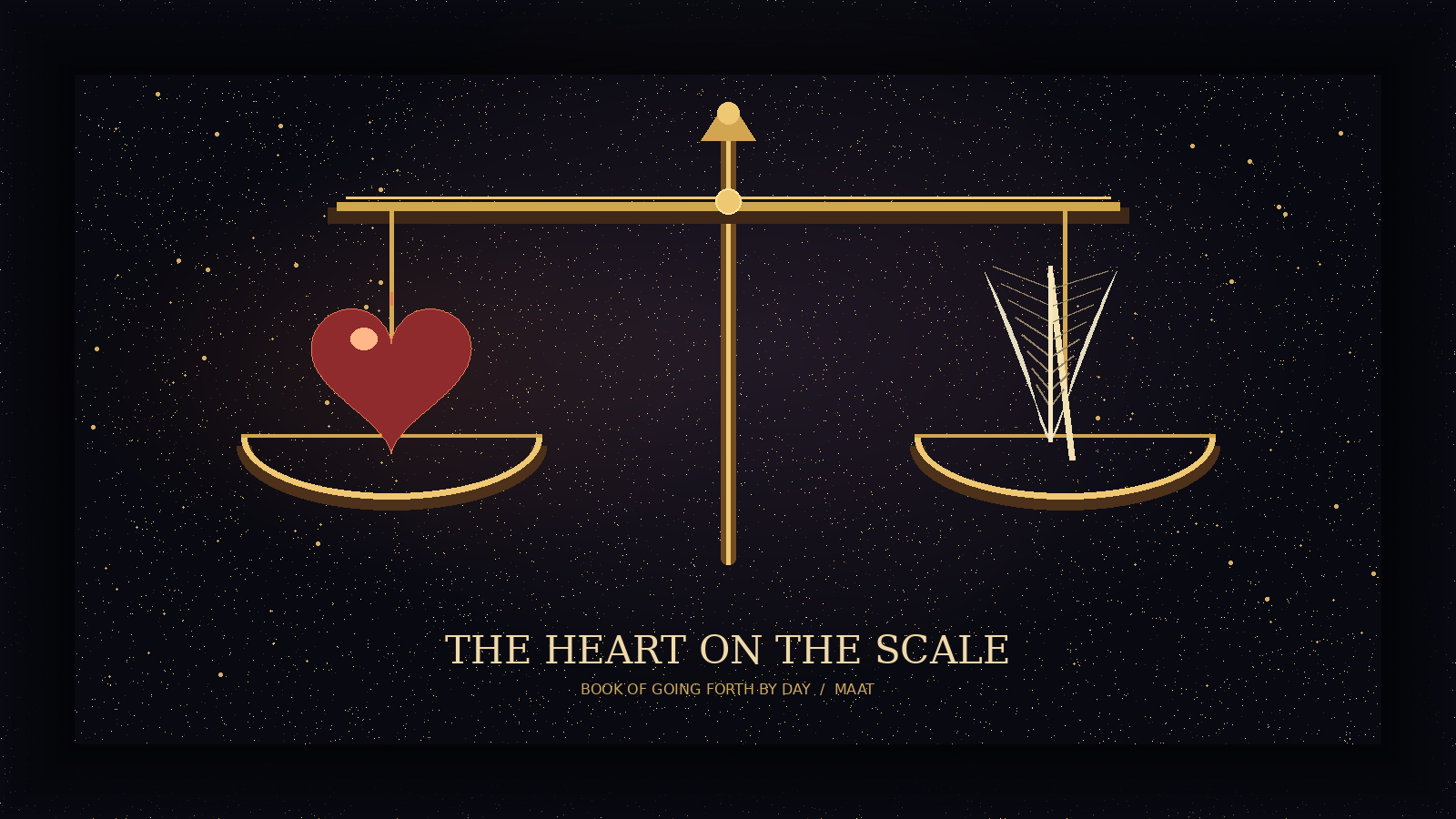
The weighing of the heart is often reduced to a moral scorecard. Read through Spell 125, the heart spells, and the surviving papyri, it becomes something more exacting: a ritual system that makes a person legible through speech, memory, material, and Maat.
Few images from ancient Egypt have travelled farther than the heart on a scale. A human heart rests in one pan. A feather rests in the other. Anubis steadies the balance while Thoth waits to write down the result. Nearby, a composite creature watches for failure. Osiris sits beyond the scene, the ruler whose presence gives the encounter its final horizon.
The modern caption is usually simple: the heart is weighed against the feather of Maat, and the dead person is judged good or bad.
The image can carry more.
What is now called the Book of the Dead was not one fixed book, and the weighing scene was not a universal moral cartoon issued in identical form to every Egyptian. The modern title hides a changing collection of spells, images, and material supports. Ancient Egyptians could call this body of work the “Book of Going Forth by Day” or “Spells for Going Forth by Day”; individual compositions could appear on papyrus, linen, coffins, walls, amulets, and other parts of a funerary assemblage.[5]
The thesis of this essay is that the weighing of the heart is best read as a technology of legibility. The dead person does not arrive as an isolated interior self carrying a private report card. The person is reassembled before a field of witnesses: a heart that must not condemn its owner, a voice that knows names, a record that can be read, a body protected by words, a soul that can go forth, and a standard represented by Maat. The scene asks whether this distributed person can remain coherent in the presence of order.
That is different from saying that ancient Egyptians invented a secular ethics test, or that a modern reader can turn the ritual into a universal self-help exercise. It is an invitation to stay close to the artifacts and let the strangeness remain precise.
The paired Vault of Arcana edition and Universal Transmissions companion essay follow the same evidence as a living transmission about memory, speech, and the problem of becoming answerable to a world larger than the self. This essay stays with provenance, textual layers, material practice, and the limits of translating Egyptian funerary religion into contemporary spiritual language.
Research note: No direct Chroma corpus query was available in this run. The article is grounded in the retrieved UCL Digital Egypt translations of Chapters 125A and 125B, British Museum records for Papyrus Ani frame 3 and heart-scarab EA29440, and Foy Scalf's Oriental Institute study of the Book of the Dead as a variable corpus. The existing Temple in Man essay is used only as a neighbouring, distinct inquiry into Egyptian architecture and the body—not as evidence for this funerary-text argument.
1. There Was No Single Book to Open
The first correction is almost grammatical. “The Book of the Dead” sounds like a bound volume with an author, a table of contents, a stable doctrine, and a final page. Foy Scalf's introduction to the Oriental Institute's Book of the Dead: Becoming God in Ancient Egypt explains why that picture misleads: the modern designation refers to a variable and complex set of texts, not a book in the modern narrative or physical sense.[5]
The ancient title Book of Going Forth by Day is more active. It names an ability rather than a shelf. In Scalf's account, “going forth by day” refers to the ba-soul's capacity to leave the tomb, enter daylight, and join the sun god's journey across the heavens.[5] The funerary corpus is therefore not simply a description of what happens after death. It is a set of words and images intended to help a person move, speak, be recognized, and participate in a renewed order.
That purpose changes how we read the famous judgment vignette. The image is not an illustration placed beside a story called The Egyptian Book of the Dead. It is one configuration in a wider repertoire. Spells could be selected, combined, shortened, expanded, or placed on different media. Manuscripts from the same broad tradition could resemble one another while remaining unique objects. The archive is a family of related operations, not a single authorized edition.
This variability is not a defect to be edited away. It is part of the historical evidence. If every papyrus is a hand-made arrangement, then the deceased was not being fitted into a universal printed template. A funerary workshop was building a passage for a particular person, with inherited formulas and local choices. The tradition was stable enough to be recognizable and flexible enough to be materially reconfigured.
The phrase “Book of the Dead” remains useful as a modern index. It becomes dangerous when it is mistaken for an ancient category with one fixed boundary. A good reading keeps the convenience of the label while remembering that the objects themselves refuse uniformity.
2. The Hall of Judgment Is a System of Witnesses
The Papyrus of Ani's judgment scene gives the modern imagination its most complete theatre. The British Museum identifies the surviving frame as a scene in the Hall of Judgment. At its centre, Ani's heart occupies one pan and a feather representing Maat occupies the other. Anubis holds the cord and steadies the plumb bob; Thoth, in ibis-headed human form, waits with palette and reed brush; a composite monster stands ready to consume the heart if Ani fails.[3]
The scene is crowded because judgment is not reduced to the balance itself. Gods sit above it. Ani enters with his wife Tutu. His ba-bird is present, associated with freedom of movement beyond the tomb. The image includes fate, birth, perception, divine speech, the embalming place, and the ruler of the dead. Even before one interprets the symbolism, the composition makes a claim about personhood: the deceased is never only the figure kneeling at the edge of the frame.
A scale by itself would suggest a measurement. The surrounding figures turn measurement into an encounter.
Anubis is not merely a decorative jackal-headed attendant. In the museum description, he is the one “in the place of embalming,” a title that places the balance beside the work of preserving the body.[3] Thoth is not simply an intellectual god inserted to make the picture interesting. He is the scribe of the gods, ready to record the result. Ammit is not a generic devil. She is the consequence waiting at the edge of the apparatus. The ba is not a synonym for “soul” that can be swapped into any later theology. It is one element in an Egyptian account of a person whose capacities have to be restored and coordinated.
This is why “the judgment of the soul” can be too vague. The scene is more materially specific. It shows a heart, a feather, a scale, a scribe, a devourer, a group of gods, a name, a spouse, and a mobile ba. Its theology is staged through relations among forms. The person becomes visible by being placed inside a network of offices and witnesses.
The balance is the centre of gravity, not the whole machine.
3. The Heart Is Not a Modern Morality Meter
The heart is the most tempting part of the scene to modernize. We can easily translate it into “conscience,” then translate conscience into a private moral psychology, and finally imagine the afterlife as a test in which hidden feelings are compared with an objective standard. That sequence may be evocative. It is not yet historical explanation.
In Egyptian funerary practice, the heart appears as a vulnerable and active part of the deceased's composition. It can testify. It can condemn. It can be protected by a spell. The wording of Chapter 30B is directed toward preventing the heart from speaking against its owner in the judgment hall. Scalf notes that the spell's early attestations include examples on heart scarabs, and that its rubric called for the text to be written on and recited over a green-stone scarab.[5]
The British Museum's record for heart-scarab EA29440 makes the material point concrete. Its underside bears the hieroglyphic text of Chapter 30B; the museum describes the function of such texts as binding the heart to silence about its owner's misdeeds when it was symbolically weighed in the underworld.[4]
A heart scarab is therefore not just a miniature souvenir of the large papyrus image. It is an intervention in the problem the image dramatizes. The heart is a witness whose testimony matters, and the amulet gives that witness a textual counterweight. The object does not tell us that Egyptians thought the muscle in the chest literally stored a modern psychological autobiography. It tells us that the heart occupied a decisive place in the ritual grammar of the person.
This is also where an easy translation into “the heart must be pure” becomes inadequate. Purity language exists in the corpus, but the spell is not a blank invitation to project any moral ideal onto it. The heart's danger is relational: it can speak against the deceased at the moment when the deceased needs to be recognized. Chapter 30B addresses the possibility that the inner witness will become an opposing witness.
The amulet does not erase accountability. It changes the conditions under which accountability can be met. The heart is not asked to become silent because truth does not matter. It is asked not to turn the judgment into a betrayal by an unstable or hostile part of the self.
That is a strange and fertile idea. A person may fail not only because an external judge condemns them, but because the pieces that make up the person cannot agree on who is standing there.
4. The Forty-Two Denials Are a Catalogue of Relations
Chapter 125B is often called the Negative Confession. The name is modern, but the form is distinctive. UCL Digital Egypt describes the deceased declaring innocence of one wrongdoing in turn before each of forty-two assessors.[2] The list is memorable precisely because it is not limited to an abstract interior virtue.
The declarations include not killing, not causing hunger or grief, not robbing, not tampering with measures or scales, not reducing offerings, not harming offering cattle, not blocking divine processions, and not obstructing water in its proper time.[1][2] There are also declarations concerning speech, sexuality, anger, theft, falsehood, gossip, and purity. The list moves between temple, field, household, marketplace, body, animal life, political order, and the handling of words.
This is not a modern checklist of personal improvement. It is a map of entanglement.
To say “I did not reduce the measuring vessel” is to place the self inside an economy of proportion. To say “I did not tamper with the plumb bob of the scales” brings justice into contact with instruments and trade. To say “I did not hold back water in its time” places ethical life within seasonal and agricultural dependence. To say “I did not cause hunger” makes another person's bodily need part of the speaker's postmortem answerability.
The list is not free of social hierarchy or ritual difference. We should not extract it from its ancient institutions and announce that it is a complete charter for modern justice. Its value is more exact than that. It shows how the ritual imagines wrongdoing as disturbance across a field of relations. The person is accountable because their actions have entered measures, offerings, households, animals, speech, land, and divine service.
UCL also notes that the written evidence begins in the New Kingdom and that later temple oaths may have been modelled on similar forms; it presents the relationship as a possibility, not an established identity.[2] That qualification matters. The Negative Confession may preserve or transform a ritual logic associated with purity before temple service, but we should not flatten a hypothesis into a certainty.
Nor should we imagine that the forty-two declarations form an immutable script. UCL's page records variations in sequence, in the matching of deities to denials, and even in the number of declarations.[2] Stability and variation coexist. The tradition gives the deceased a recognizable architecture of answerability while allowing the manuscript to carry local and historical differences.
The list is best understood as a distributed test: can the person speak truthfully within the offices, measures, needs, and relationships that made life possible?
5. Maat Is More Than a Feather
In the Papyrus of Ani frame, the feather opposite the heart represents Maat. The British Museum describes Maat as the divine personification of truth and order.[3] That museum wording is useful, but even it should not be turned into a single English equivalent that solves the term forever.
Maat is often rendered as truth, justice, order, or rightness. Each translation catches something and loses something. In the judgment scene, the feather is not simply a moral grade printed on a card. It is a standard that belongs to a divine and cosmic order, yet it becomes visible through a material object in a working balance. The scale does not compare the heart with an abstract idea floating outside the world. It places the heart in a relation to the order that should let gods, people, offerings, speech, and time remain viable.
This helps explain why the Negative Confession ranges across seemingly different actions. The list does not need every wrongdoing to be a variant of “being a bad person.” It needs actions to be measured against a world in which life depends on proper relation. Maat is not only interior sincerity. It is a condition of the field in which sincerity, nourishment, measurement, ritual, and speech can have consequences.
The feather also prevents the scene from becoming a contest between two private weights. The heart does not carry its own standard. The standard is represented by another order, personified and witnessed. The self must answer to something it did not invent.
A contemporary reader can recognize the force of that image without pretending to occupy the same religious world. Our age is skilled at making the self its own court, its own metric, and its own brand. The feather interrupts that loop. It asks whether the measure by which we live was created only to excuse us.
But the modern application has to remain an application. It should not be presented as what ancient Egyptians “really meant” in a timeless psychological sense. The historical claim is about the way the surviving scene and spells arrange person, standard, speech, and witnesses. The contemporary reflection is ours.
6. Speech Does Not Merely Describe the Person
Chapter 125A begins with arrival at the broad hall of the Two Goddesses of What is Right. In the UCL translation, the deceased addresses Osiris, names the god, names the forty-two gods in the hall, and declares that Maat has been brought and wrongdoing removed.[1] The speaker's knowledge of names is part of the entrance.
This is not simply a report delivered after the important events have already happened. Speech is one of the actions that makes the encounter possible. The deceased must know whom they face, where they have arrived, and how to place themselves in the grammar of the hall. A name is not only a label attached to an already complete individual. In a ritual environment, accurate naming demonstrates relation and grants passage.
The same principle appears in the structure of the denials. “I have not…” is repetitive, but repetition is not empty. It stages the person one relation at a time. The speaker does not offer a poetic summary such as “I was generally decent.” They answer specific offices with specific claims. A life becomes legible by passing through particulars.
There is a tension here that modern readers often miss. The formulas can sound like defensive legal language, yet their rhythm is also constructive. The person is not merely hiding faults. They are assembling an identity capable of being recognized by divine administration. The voice moves through the hall, and in moving through it, it locates the speaker.
That is why the scribe matters. Thoth records, but the record is not a neutral transcript outside the ritual. Writing, speech, image, and balance cooperate. The museum's description of Ani's scene emphasizes the close arrangement of the balance, the scribe, the gods, and the other figures.[3] The picture is an epistemology in miniature: truth is not only what the heart contains, but what can be spoken, witnessed, measured, and entered into a record.
This does not make the ritual bureaucratic in the modern administrative sense. It makes bureaucracy a useful analogy if we keep it poetic and limited. The dead person faces a divine order in which offices, names, instruments, and records are not separate from sacred reality. To pass is to become readable across several media at once.
7. The Archive Was Wrapped Around the Person
The material setting deepens the argument. Scalf describes Book of the Dead spells appearing not only on papyrus but also on linen bandages, cartonnage, coffins, sarcophagi, funerary figures, stelae, magic bricks, and tomb walls.[5] A spell could be written on an object, attached to the body, placed near it, or integrated into the space through which the dead person would be imagined to move.
This is an archive with a body.
A modern book holds information between covers and asks a reader to open it. A funerary spell can be placed under a heart, around a body, on a coffin, or at the architectural edge of a tomb. The location is not an accidental container. It is part of the intended action. A text that protects the heart belongs near the heart. A text that enables movement belongs within a larger route of movement. A vignette does not merely explain a spell; it gives the spell a visual body.
Scalf's discussion of BD 30B is especially striking because it suggests that the earliest attested example of a Book of the Dead spell is not on a papyrus “book” at all, but on a heart scarab.[5] The supposed centre of the corpus begins, in this case, as a small object attached to the problem of a particular body.
The implication is not that every Egyptian funerary object had one hidden master plan. It is that transmission can begin in use rather than in a canonical volume. A formula is preserved because it does something. Later it can be copied into a wider collection, placed beside other spells, or given a more elaborate vignette. The archive grows by accumulation, adaptation, and recontextualization.
This is one reason digital collections can be both powerful and misleading. A scan makes dispersed objects searchable, but the search interface can turn an amulet, a linen strip, a papyrus, and a tomb wall into interchangeable pages. They are related as textual and ritual witnesses; they are not the same kind of thing.
Reading the Book of the Dead responsibly means asking not only, “What does this passage say?” but also, “Where was it placed, for whom, in what material, and with what neighbouring image?” The person on the other side of death is being carried by a material ecology.
8. Becoming Legible Is Not the Same as Becoming Innocent
The phrase “technology of legibility” can sound clinical, so it needs a boundary. The judgment scene does not reduce religion to an information system. It is not an ancient database diagram, and the Egyptian gods are not software components waiting for a systems analyst to decode them.
The phrase names a structural feature of the scene: the person must be present in several registers at once. The heart must not turn against its owner. The voice must address the right powers and make specific denials. The manuscript must preserve the words. The image must show the relations. The body and its amulets must carry the protection. The ba must retain a capacity for movement. Maat must provide the order against which the encounter is meaningful.
That is legibility, not data extraction.
It also is not identical to innocence. Chapter 125A's declarations are forceful, but the very existence of the heart spell implies anxiety about what may happen in the hall. If the ritual were a simple declaration that the deceased had never done wrong, there would be no need to protect the heart from speaking against them. The system contains fear, uncertainty, and the possibility of failure.
Nor does the heart scarab provide a loophole in which an amulet mechanically cancels a life. It is better understood as part of a network of preparation. Text, recitation, material, placement, and ritual intention work together. A charm is not an excuse to ignore the order it invokes.
The scene holds two ideas together: the person must answer, and the person needs help becoming capable of answering. Protection is not the opposite of judgment. It is what allows the deceased to enter judgment as a coherent participant.
This tension resonates with a broader human problem. We want to be honest, but we also want the inner witness to be kind. We want memory to tell the truth without becoming a weapon. We want a record of our life that does not erase our failures and does not reduce us to them. The Egyptian image does not resolve that problem for us. It gives the problem an unforgettable shape.
9. What Modern “Egyptian Wisdom” Usually Leaves Out
Modern esoteric writing often treats Egypt as a sealed container of universal wisdom. The pyramids become a single initiation machine; hieroglyphs become a timeless code; every god becomes a psychological archetype; Maat becomes a slogan for positive living. Such readings may generate compelling art and personal reflection. They also flatten historical distinctions.
The funerary corpus resists that flattening in several ways.
First, its texts have periods and transmission histories. UCL's account places the written evidence for Chapter 125 in the New Kingdom and records later variation.[1][2] Scalf shows that the Book of the Dead is connected to earlier funerary corpora and later developments, but not as a single volume with a single moment of origin.[5] “Ancient Egyptian wisdom” is therefore not one voice speaking outside time.
Second, the objects have owners. Papyrus Ani is not an anonymous universal scroll; the British Museum record identifies Ani, his wife Tutu, the frame, its date, and its findspot context.[3] The heart scarab EA29440 has its own material and inscriptional history, even though no owner is named in the record.[4] The tradition is personal because it is attached to people and objects, not because it has been abstracted into a universal personality test.
Third, the symbols are not interchangeable. A feather of Maat, a heart scarab, a ba-bird, Thoth's palette, and Ammit's body belong to a particular visual and religious syntax. Comparative work can place them beside symbols from other traditions, but comparison should produce sharper questions rather than a declaration that all systems secretly say the same thing.
This is the distinction between a living archive and a fantasy of total access. The archive gives us more material. It does not remove the responsibility to identify period, genre, medium, and uncertainty.
The Ancient Egypt Mysteries & Sacred Traditions Archive can be useful as a research shelf for that comparative work: Egyptology, hieroglyphs, temples, and ancient history gathered in one place. Read it as a shelf, not as an oracle. Compare editions. Separate primary translations from later occult interpretations. Note which claim belongs to a museum record, which to a scholar, and which to a modern author making a new synthesis.
10. A Practice of the Feather, Without Pretending to Be Egyptian
The historical material can still change how we live, but the direction of that change should be explicit. The following is not an ancient Egyptian ritual, a reconstruction of temple service, or a substitute for study with Egyptian sources. It is a contemporary reading exercise prompted by the structure of the scene.
Begin with the witness. Choose one action from the UCL list—speech, measurement, hunger, anger, theft, care for animals, or the handling of another person's property. Do not turn it into a vague affirmation. Name the relation it creates.
Add the instrument. Ask what object, office, or environment carried that relation. A scale, a ration, a doorway, a contract, a kitchen, a message, a body. The Egyptian list is powerful because it attaches conduct to things. Let your reflection become concrete.
Separate confession from self-condemnation. The point is not to produce a dramatic identity called “pure” or “impure.” It is to make one action visible without hiding behind an atmosphere. What happened? Who was affected? What repair is possible?
Let the heart speak, but do not let it become the only court. Inner feeling matters, but feeling is not the whole measure. Place it beside consequences, testimony, memory, and the needs of others. A heart can be sincere and still be mistaken. A heart can be ashamed and still be incapable of seeing another person.
Close with a return. The Book of Going Forth by Day is concerned with movement. Let the reflection end in an action that returns to the shared world: correct a measure, restore a promise, feed someone, clarify a claim, or stop repeating a story that injures another person. The point is not to cosplay an ancient afterlife. It is to let the image interrupt abstraction.
This exercise belongs to us. It is a response to the structure of the source, not a recovered Egyptian rite. That distinction is part of respect.
Questions From the Hall
What is the weighing of the heart in the Egyptian Book of the Dead?
It is the judgment scene associated especially with Book of the Dead Chapter 125, in which the deceased's heart is shown weighed against a feather representing Maat before Osiris. Papyrus Ani frame 3 depicts the balance, Anubis, Thoth, the gods, the devouring monster Ammit, Ani, Tutu, and the ba bird.[1][3] The scene is better understood as a ritual-theological model of passage and recognition than as a modern courtroom diagram.
Is the Book of the Dead one book?
No. “Book of the Dead” is a modern label for a variable collection of spells and vignettes. Ancient Egyptians used titles such as “Book of Going Forth by Day” and “Spells for Going Forth by Day.” The compositions could appear on papyrus, linen, coffins, walls, amulets, and other funerary media, and no two manuscripts were exactly alike.[5]
What are the forty-two declarations?
In Chapter 125B, the deceased declares innocence of one wrongdoing before each of forty-two assessors in the UCL presentation.[2] The statements address a wide range of relations, including violence, theft, speech, hunger, offerings, measurement, water, sexuality, and purity.[1][2] Versions vary in sequence, deity associations, and even number, so the list should not be treated as an immutable universal script.[2]
What is Maat?
Maat is commonly translated through words such as truth, justice, order, or rightness. In the British Museum's description of Papyrus Ani frame 3, the feather represents Maat as the divine personification of truth and order.[3] The surviving scene gives Maat a material and divine presence; it should not be reduced to a generic modern slogan about being positive or morally good.
Why was Chapter 30B placed on a heart scarab?
Chapter 30B addresses the heart's potential to speak against its owner in the judgment hall. Scalf notes early attestations of the spell on heart scarabs, and the British Museum records an EA29440 heart-scarab whose underside carries the Chapter 30B text.[4][5] The object shows how a funerary text could operate through material placement, not only through a papyrus scroll.
Does the weighing of the heart prove that ancient Egyptians believed the heart stores a person's moral data?
It shows that the heart had a central role in the ritual and theological construction of the deceased. It does not justify importing a modern biomedical theory into the source. The heart in the spell and the heart in the image are part of an Egyptian account of personhood, speech, memory, and judgment; they are not evidence for a contemporary claim about organs storing moral information.
Can I use this as a daily spiritual practice?
You can use the image as a contemporary reflection on conduct, measurement, speech, and repair, as long as you label the adaptation honestly. It is not a reconstruction of ancient Egyptian temple ritual, and a blog essay cannot stand in for Egyptian-language scholarship or a living religious community. Let the source sharpen your attention rather than granting your interpretation ancient authority.
The Archive Path
The heart on the scale is not a diagram of a person being reduced to a number. It is a picture of a person being gathered for recognition.
The heart, voice, name, image, amulet, body, ba, gods, scribe, devourer, and feather form a field. Each part answers a different question. Can the witness be trusted? Can the voice speak? Can the record hold? Can the body carry the words? Can the self move? Can the life stand in relation to Maat without inventing its own measure?
That is why the image still feels alive. It does not promise that a hidden essence will save us from consequence. It asks whether the parts of a life can meet one another without turning the judgment into either denial or annihilation.
Continue with the Universal Transmissions companion transmission, where the same archive becomes a meditation on memory, speech, and returning to the shared world. For the historical shelf behind this essay, open the Ancient Egypt Mysteries & Sacred Traditions Archive. Its value is comparative: read Egyptology, hieroglyphic studies, temple history, and later esoteric interpretations beside one another, and keep their voices distinct.
Then place this funerary text beside the Temple in Man study, not to claim that every Egyptian monument says one thing, but to watch two very different readings ask how a human being can be made visible through architecture, body, inscription, and proportion.
The scale does not close with a score. It closes with a question: when the life is placed among its witnesses, what kind of truth can still speak?
Sources
[1] https://www.ucl.ac.uk/museums-static/digitalegypt/literature/religious/bd125a.html — UCL Digital Egypt: Book of the Dead Chapter 125A [2] https://www.ucl.ac.uk/museums-static/digitalegypt/literature/religious/bd125b.html — UCL Digital Egypt: Book of the Dead Chapter 125B [3] https://www.britishmuseum.org/collection/object/Y_EA10470-3 — British Museum: Papyrus of Ani, frame 3 [4] https://www.britishmuseum.org/collection/object/Y_EA29440 — British Museum: heart-scarab EA29440 [5] https://isac.uchicago.edu/sites/default/files/uploads/shared/docs/Research_Archives/Offprint%20-%20Scalf%2C%20Foy%20-%20What%20is%20the%20Book%20of%20the%20Dead%20-%20OIMP%2039.pdf — Foy Scalf (ed.), Book of the Dead: Becoming God in Ancient Egypt
Continue the weighing-of-the-heart study into an Egyptology and Kemetic source shelf — hieroglyphs, funerary texts, temples, and the historical material behind the transmission.
OPEN THE EGYPTIAN ARCHIVE →