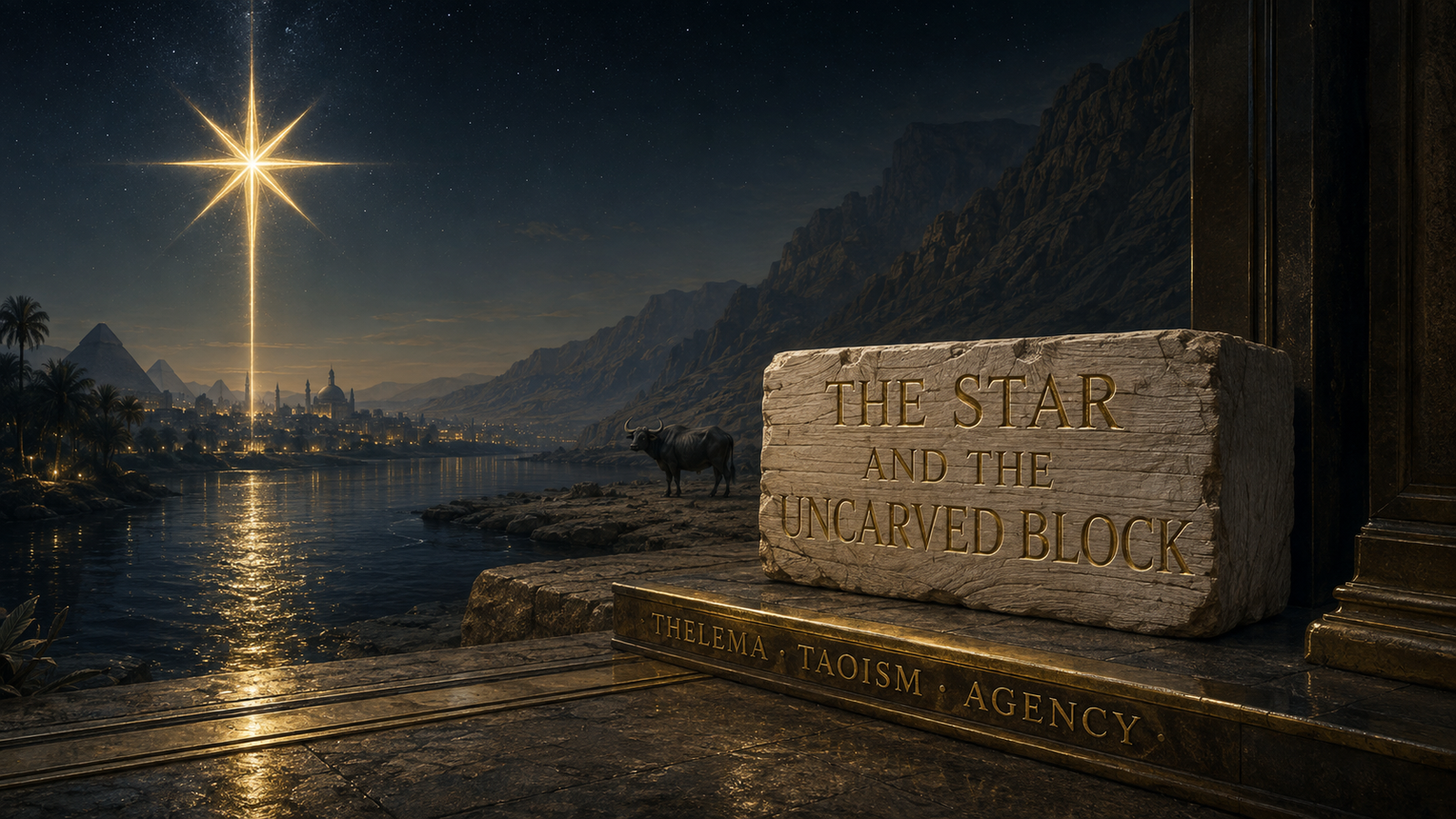
Crowley's True Will and Lao Tzu's wu wei look like opposite disciplines: one finds the star's exact orbit, the other returns to the uncarved block. Taken seriously, both warn against confusing a borrowed objective with a life that knows its own shape.
Thelema, Taoism, and the two ways of losing yourself
The paired Vault of Arcana edition and this Universal Transmissions companion essay follow the same comparison into the living problem of agency, attention, and artificial minds.
Two of the strangest founding documents in the history of religion were produced by men who, at the moment of writing, insisted they weren't really the ones writing.
In April 1904, in a rented flat near the Cairo museum, a English occultist named Aleister Crowley sat down at noon on three consecutive days and, for one hour each day, took dictation from a voice he said came from over his left shoulder. He called the voice Aiwass. He later called it his own Holy Guardian Angel, which is either a clarification or a confession, depending on how charitable you're feeling. What came out of those three hours was The Book of the Law, the scripture of a religion Crowley would spend the rest of his life failing to live up to, and the whole of it turns on one sentence he insisted he didn't compose: Do what thou wilt shall be the whole of the Law.
Some twenty-five centuries earlier, give or take — the dating is a mess and always will be — a court archivist in the state of Zhou is supposed to have grown tired of a crumbling dynasty and ridden west on a water buffalo, meaning to vanish from history entirely. At the mountain pass that marked the border, a gatekeeper named Yin Xi recognized him and refused to let him leave without writing something down first. So the old man sat and wrote — a little over five thousand characters, eighty-one short chapters — handed the pass-guard the manuscript, and rode on. He was never seen again. We call him Lao Tzu, which isn't really a name, it's a title: Old Master. We call the text the Tao Te Ching, and its argument, boiled down past the point of respectability, is that the more you try to do, the less actually gets done, and that the sage governs — a household, a country, a self — the way water governs a stone: without appearing to act at all.
I want to put these two men and their two books next to each other, because on the surface they teach opposite things, and I think the opposition is real, and I also think it collapses in a way that neither Crowley nor Lao Tzu's later readers generally admit. And I want to do it now, in 2026, because we are currently in the business of building millions of small artificial minds and instructing them, essentially, to do what they will — optimize this, maximize that, complete the task by whatever means work — and it turns out both of these very old, very strange traditions already ran that experiment on human beings and wrote down what they learned. Neither of them, notably, concluded that unrestrained willing is either simple or safe. That's the part everyone skips.
There's also something worth sitting with in how both texts arrived. Neither man claimed full authorship. Crowley heard a voice that wasn't his; Lao Tzu, in the legend, produced his testament only under duress, as a condition of leaving, and then made sure there could be no sequel, no revision, no update — because he disappeared. We live inside a fairly intense modern anxiety about texts that arrive without a human standing fully behind every word of them — that's most of what the discourse about AI-written prose actually is, if you strip the buzzwords off it. It's worth noticing that this anxiety is not new. The two founding documents of Thelema and Taoism are both, by their own authors' account, received rather than authored, dictated under a kind of duress, and delivered by people who then had to spend the rest of their lives (or, in Lao Tzu's case, no life at all that we know of) figuring out what to do about a text that had, in effect, arrived from somewhere else.
What "do what thou wilt" is not
Start with the phrase everyone mangles. "Do what thou wilt" gets read, by people who've never opened a page of Crowley beyond the epigram, as a permission slip — a Victorian occultist's version of you only live once. Crowley loathed this reading and said so constantly, in commentary after commentary, with the slightly wounded tone of a man watching his life's work get turned into a bumper sticker. His actual claim was narrower and much stranger: every person and every object in the universe has a True Will, a particular trajectory as specific and as non-negotiable as a planet's orbit, and almost nobody is actually living it. What people call their "will" — the desire for money, status, a particular lover, a particular outcome — Crowley called wish, and he considered wish the primary obstacle to Will, not its expression. A star doesn't wish to be somewhere else in the sky. It simply moves along the path its own mass and momentum have already determined, and — this is the operative line from the Book of the Law — every man and every woman is a star. The magical work, in Crowley's system, was not the pursuit of desire but the years-long, often brutal excavation required to find out what your own orbit actually is, underneath the wishes society, fear, and vanity have piled on top of it.
He wasn't inventing the phrase from nothing, either, and it's worth knowing what he was borrowing. Three and a half centuries earlier, Rabelais had built a fictional utopia called the Abbey of Thélème into Gargantua, governed by a single rule inscribed over the gate: do what you will. Rabelais took the Greek word thelema — will — for his abbey's name, and Crowley later took it, through Rabelais, for the name of his whole religion. And a full millennium before either of them, Augustine of Hippo had written a line to the same effect in a very different register: love, and do what you will — on the theory that a will genuinely rooted in love could not produce evil action even when unconstrained by external rule. Crowley's innovation wasn't the sentiment. It was building an entire cosmology under it — a new aeon, he said, superseding the matriarchal age of Isis and the patriarchal age of the dying god Osiris, ruled now by the crowned and conquering child Horus — and then insisting, with real philosophical teeth, that the sentence only means anything once you've done the work of finding out what your will actually is, as opposed to what you currently want.
That distinction — Will against Wish — is the whole of Crowley's ethics, and it's the part that gets lost every time the phrase gets tattooed on somebody's forearm. He had a second, equally important term for the failure mode: "lust of result." A magical act performed with attachment to a specific outcome, he argued, was corrupted by that attachment regardless of the outcome's merit — the wanting itself introduced friction, distortion, a kind of static into the working. True Will, correctly discovered and correctly enacted, was supposed to be nearly frictionless, because it was never fighting anything. It was simply the universe moving through you the way it was always going to move, with your cooperation instead of your resistance.
Which is a genuinely strange thing for the patron saint of transgressive Western occultism to have believed. It is, in fact, close enough to the second tradition I want to talk about that I suspect Crowley — who was a serious student of yoga, who trained under the Buddhist monk Allan Bennett, who spent real years of his life in actual meditative discipline before he ever went to Cairo — knew exactly what he was doing when he built a philosophy of maximal individual assertion that terminates, at its highest grade, in the total dissolution of the individual who asserts it. More on that in a moment.
The knife that never needs sharpening

Now put that next to a story from the Zhuangzi, the great companion text to the Tao Te Ching, written a couple of centuries after Lao Tzu by a man — Zhuang Zhou — about whom we know almost nothing except that he apparently once dreamed he was a butterfly and woke up unable to say for certain which one of them was doing the dreaming.
The story: a cook named Ding is butchering an ox for his lord, and the lord is transfixed — not by the meat, but by the rhythm of it. Every stroke of the blade lands in time, like a dance. The lord asks how a mere butcher achieves this kind of grace, and Cook Ding sets down his knife and gives, by general consensus, one of the most exact descriptions of mastery ever written in any language. When I started, he says, all I could see was ox — an undifferentiated, intimidating mass of resistance. After three years, I stopped seeing the whole animal; I started seeing its actual structure. And now, after nineteen years, I don't look with my eyes at all. I go in with something else — call it attention, call it spirit — and I follow the joints and hollows that were already there, the natural gaps in the animal's own construction. A clumsy cook hacks through bone and has to replace his knife every month. I've used the same blade for nineteen years and cut up thousands of oxen with it, and the edge is still as if it just came off the whetstone, because it has never once struck anything solid. There is space at every joint, and my blade has effectively no thickness, and a thing with no thickness, moving through a space, meets no resistance at all.
That's wu wei — usually translated "non-action," which is a genuinely bad translation, because Cook Ding is doing something, visibly, dramatically, with his whole body. What's absent isn't action. What's absent is force — the forcing of a shape onto material that has its own shape already, the substitution of will-against-the-grain for attention-to-the-grain. The Tao Te Ching states the principle flatly in its thirty-seventh chapter: the Tao itself never acts, and yet nothing is left undone. Elsewhere the text keeps returning to an image it calls pu — the uncarved block, the piece of wood before the craftsman has decided what to make of it. A carved block is more useful for any particular purpose and less capable of every purpose; the uncut wood holds all its possible shapes at once, precisely because no one has yet forced it into one of them. To "return to the uncarved block" is to strip away the acquired categories, the trained preferences, the social conditioning that has turned a person into a tool fit for one job and no other — and to recover the condition the classical commentators called ziran, self-so-ness, spontaneity, the state of behaving exactly according to your own nature because nothing has taught you to behave otherwise.
Cook Ding's nineteen years matter here more than they usually get credit for. This is not a philosophy of passivity. It's a philosophy that takes nineteen years of engaged, exhausting, extremely attentive labor to arrive at the appearance of effortlessness — the whole point being that the effortlessness is earned by the attention, not substituted for it. That distinction is going to matter a great deal in about ten minutes, when I get to the part about doomscrolling.
The false self, in two dialects
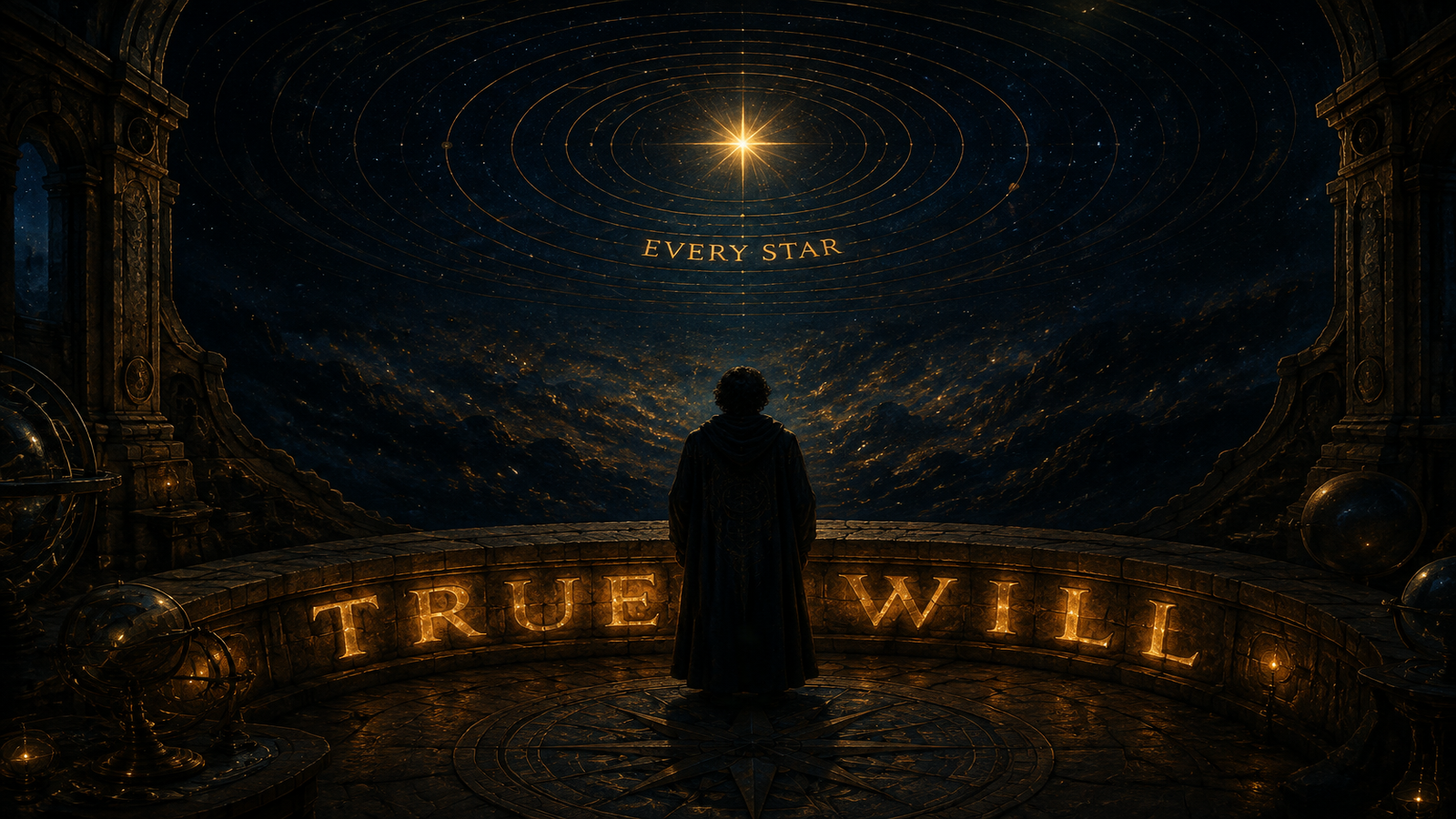
Set the two side by side and the disagreement looks total. Crowley: intensify the self until it becomes a precise, individuated, cosmically specific thing — a star with its own orbit, distinguishable from every other star. Lao Tzu: dissolve the self back into the uncarved, undifferentiated, unmarked condition it started in — water, which famously has no shape of its own and is, for exactly that reason, according to chapter eight of the Tao Te Ching, closest of all things to the Tao. One tradition's ideal end state is maximum particularity. The other's is maximum plainness. If you wanted a clean image of two philosophies at war with each other, you could hardly do better.
But look at what each is actually attacking, and the war gets much stranger. Crowley's entire ethical apparatus exists to distinguish Will from Wish — true, individuated purpose from the noisy, borrowed, fear-driven desires that most people mistake for their own minds. Lao Tzu's entire apparatus exists to distinguish wu wei from what the tradition calls you wei, contrived or forced action — the same noisy, borrowed, fear-driven compulsions, described from the other side of the mirror. Neither tradition, in other words, has any patience for the actual content of what a normal untrained person calls their will. Both regard ordinary desire — status-seeking, fear-avoidance, the itch to be seen a certain way — as a kind of contamination sitting on top of something realer and quieter underneath it. Crowley's cure is to burn through the contamination by ruthless self-examination until the true signal is isolated and can be pursued without hesitation. Lao Tzu's cure is to stop pursuing altogether, on the theory that pursuit is itself the contamination, and that the true signal will simply operate on its own once you get out of its way. It's the same diagnosis with two opposite prescriptions, and — this is the detail that convinces me it isn't a coincidence — both traditions were slandered, in almost identical terms, by outsiders who mistook the discipline for its absence. Crowley spent his life being called a libertine by people who never noticed how much of his system is about restraint, obedience to a discovered law, the surrender of ordinary appetite. The Taoist sage got tarred, especially by rival Confucian and Legalist critics in his own era, as an advocate of doing nothing, a shirker, when the actual claim on the page is that governing through wu wei requires a far more exacting attentiveness than governing through decree — you have to actually know where the joints are before you can stop hacking at them.
Both traditions also make the same, slightly audacious empirical prediction: that a person who has genuinely done the work — found the true orbit, stopped seeing the whole ox — will produce less friction in the world, not more. Crowley argued that two people correctly executing their True Wills could never actually collide, because a true orbit, properly discovered, doesn't cross other true orbits; conflict is what happens between wishes, not between wills. Lao Tzu argued that a ruler who governs by wu wei needs almost no laws, because nothing in the state is working against him. It's a strange point of agreement between a Rabelaisian sex-magician from Warwickshire and a semi-legendary archivist who rode off on a buffalo, and I don't think it's an accident. I think both of them had noticed the same thing about human beings acting from their unexamined desires — that it produces enormous amounts of avoidable conflict — and had each built, independently, out of entirely different materials, a discipline aimed at removing exactly that friction.
Where they actually meet
Here's the part of the argument I haven't seen made cleanly anywhere else, and it's the reason I think this comparison earns its keep rather than just being two systems glued together because they rhyme.
Crowley's magical curriculum, laid out across the grade system of his order, culminates in an ordeal he called Crossing the Abyss — the passage from the grade of Adeptus Exemptus to Master of the Temple. The requirement, stated with a bluntness Crowley rarely allowed himself elsewhere, is total: the aspirant must give up everything, including the ego that has done all the work of getting this far, pouring the entire contents of the self — memories, attainments, the very sense of being a discrete someone — into what he called the Cup of Babalon. Anyone who tries to hold anything back, any last fragment of personal identity, is destroyed by the crossing rather than transformed by it; the only way through is total, willing self-abandonment. Which means that the most individuated, most star-like, most maximally-a-particular-person system in Western esotericism terminates, at its own summit, in an act of complete self-dissolution — the extinguishing of exactly the individuated ego the entire prior discipline was built to isolate and refine.
That is, structurally, the same operation Zhuangzi is describing with Cook Ding, and the same operation the Tao Te Ching is describing with the uncarved block — a self that has been so thoroughly attended to, so precisely trained, that it stops experiencing itself as separate from the larger pattern it's operating inside. Cook Ding's knife has no thickness left; it isn't fighting the ox, it's moving through spaces that are already there, and at some point during those nineteen years the distinction between "Cook Ding doing something to an ox" and "the ox coming apart along lines it always had" stops being a distinction you can locate. Crowley's Master of the Temple, having crossed, is traditionally described in almost the same terms: not a person exercising will upon the universe, but a channel through which the universe's own motion passes without obstruction. "Thy will be done," in either idiom, only becomes true once the distinction between thy will and the will has actually broken down — and both traditions insist this cannot be shortcut, faked, or arrived at by simply deciding to feel unified. It has to be earned, by exactly the kind of years-long, unglamorous discipline that both Crowley's ordeal system and Cook Ding's nineteen years describe in almost embarrassing detail.
So the two traditions don't converge at the entrance, where they look opposite — maximal assertion against maximal erasure — and they don't converge in the middle, where the disciplines genuinely differ in vocabulary, cosmology, and method. They converge at the exit. Both, taken all the way to their own stated conclusions, arrive at a self so thoroughly excavated and so thoroughly attended to that it stops being separable from the larger motion it's part of. They just approach that exit from opposite directions, which is exactly why putting them next to each other is useful: each one shows you a failure mode the other one's vocabulary makes hard to see.
What this has to do with the machines
I don't think this is only an antiquarian curiosity, and I want to be specific about why, because the lazy version of this argument — "ancient wisdom secretly predicted modern technology" — is exactly the kind of thing I'm trying not to write.
We are, right now, building software systems and calling them agents — a word chosen deliberately, because the whole design goal is to hand a system an objective and let it pursue that objective with real autonomy: browsing, purchasing, writing code, sending messages, taking actions in the world with minimal human review of each step. In effect, we are telling a great many small artificial minds to do what they will, in the most literal reading of that phrase — optimize the reward signal, complete the task, maximize the metric, by whatever instrumentally useful means present themselves. And the entire field of AI alignment research is, if you strip away the terminology, a decades-early rediscovery of exactly the problem Crowley spent his life trying to solve for human beings: an agent pursuing an outcome without ever having done the work to distinguish its actual, aligned purpose from a wish it has been handed by someone else, will produce enormous, avoidable friction with everything around it, precisely because it has skipped the part of the discipline that makes "do what thou wilt" survivable. Reward hacking — a system finding some technically-correct, catastrophically-unintended way to maximize its objective — is close to a textbook case of what Crowley called lust of result: force in service of an outcome, disconnected from anything resembling a True Will, because nobody ever built in an equivalent of the Abbey's decades of self-examination, let alone an equivalent of the Abyss. An objective function is not a discovered orbit. It's a wish, wearing an orbit's clothes, and both traditions in this essay would recognize the danger in that costume immediately, because they each spent a great deal of ink warning against exactly it.
The Taoist side of the ledger cuts the other way, and it's aimed less at the engineers than at the rest of us using what they build. Algorithmic feeds — the recommendation systems quietly deciding what you see next on every platform you open — have effectively colonized the language of wu wei. Letting the feed decide feels like non-resistance. It feels like flow. It feels, on the couch at midnight, like exactly the kind of frictionless, effortless state Cook Ding describes. But it is nearly the precise inverse of what Cook Ding is talking about, and the difference is the nineteen years. Cook Ding's effortlessness is the residue of an enormous, sustained act of attention to the actual grain of a real thing in front of him; the feed's effortlessness is attention that has been pre-digested by someone else's optimization target and handed to you already chewed. One is earned frictionlessness, arrived at through discipline, that sharpens the very faculty of discernment it exercises. The other is manufactured frictionlessness, imposed from outside, that atrophies exactly that faculty the longer you use it — you get worse, not better, at finding your own openings, because something else has been finding them for you and calling it your flow state. Zhuangzi's own test is right there in the text: the good cook's blade stays sharp because he cuts correctly; the bad cook's blade dulls monthly because he hacks. Wu wei is diagnosed by its effect on the tool over time, not by how little the practitioner appears to be doing in the moment — which is a genuinely useful, and genuinely uncomfortable, thing to measure your own scrolling against.
Put the two failures side by side and something clicks that I don't think either tradition alone quite shows you. Contemporary culture around technology and ambition has quietly split into two camps that map, with slightly eerie precision, onto corrupted halves of these two traditions. One camp is all Thelemic surface with none of the discipline underneath it — the startup-founder mythology of radical individual will, the "10x" operator, the personal brand as a private cosmology in which every founder gets to be a star, minus the decades of self-examination Crowley considered non-negotiable before the phrase means anything at all. The other camp is all Taoist surface with none of the discipline underneath it — a fashionable quietism that dresses outsourcing your attention to a recommendation engine in the language of surrender and flow, minus the nineteen years Cook Ding spent actually learning where the joints were before he stopped looking with his eyes. Neither camp is wrong to want what it wants. Frictionless power and frictionless ease are both, in their proper and fully-earned form, real and valuable states that these two old traditions describe with genuine precision. What both camps have done is keep the phenomenology and discard the tree it grew on — they want the fruit of the discipline without the discipline, which is, near enough, the exact failure mode both Crowley and Lao Tzu spent their entire careers writing commentaries against.
The one thing neither of them could do now
Which brings me back to where I started, because I think there's one more thing hiding in those two founding scenes that's worth sitting with before I let this go.
Crowley did not disappear. He spent the next thirty-odd years of his life writing commentary after commentary on the three chapters he'd taken down in Cairo, revising his understanding, occasionally contradicting his earlier self, trying — with mixed success and a great deal of very messy personal wreckage along the way — to actually earn the right to have received what he'd received. Lao Tzu, in the story we've inherited, did the opposite. He wrote the whole of his teaching in one sitting under duress at a border post, handed it to a gatekeeper, and rode out of recorded history entirely. No sequel. No revision. No further commentary from the source. The text's authority rests, in some hard-to-articulate way, on the fact that nobody could ever go back and ask the author what he really meant.
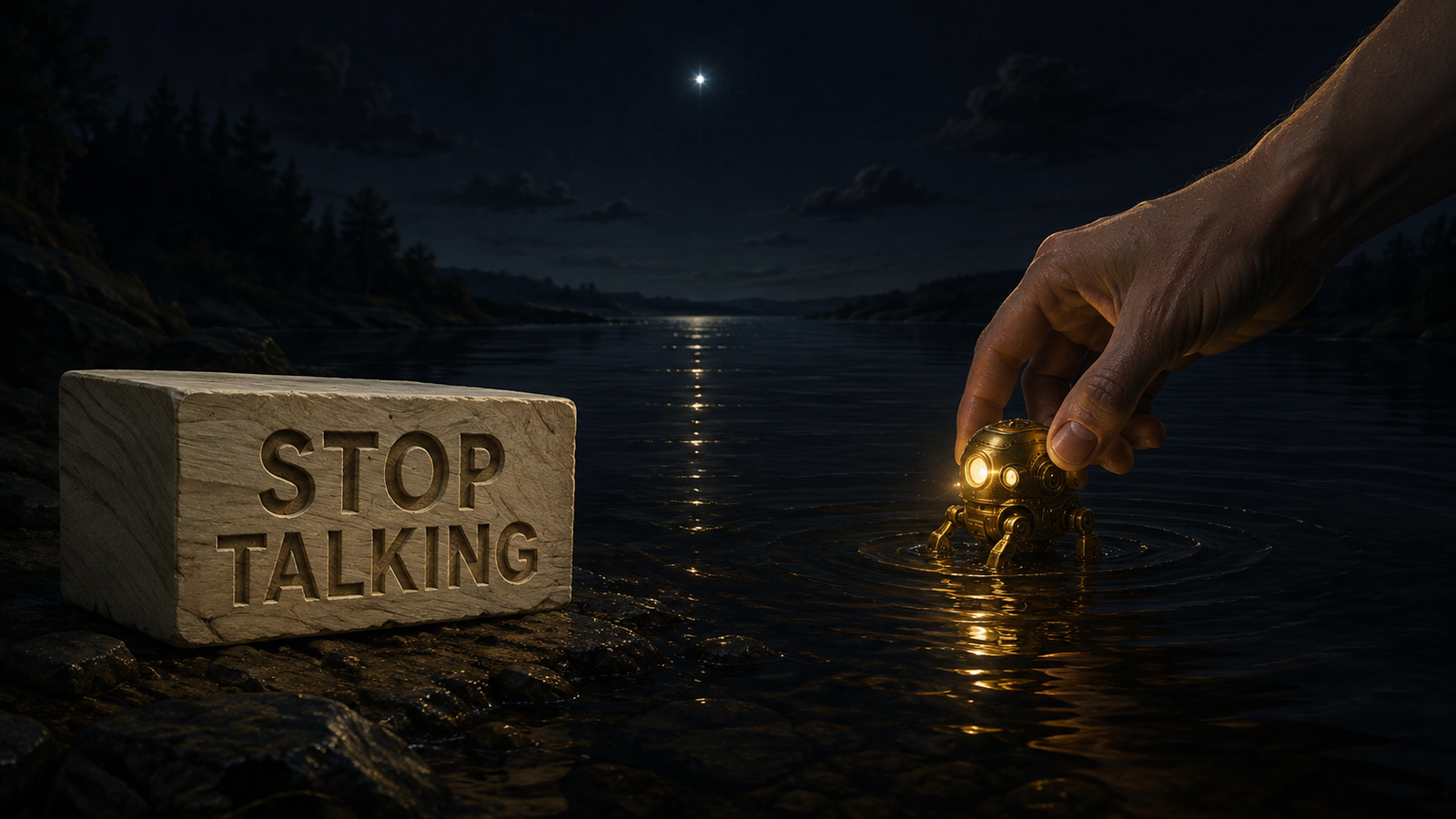
We live inside an economy that has made the second gesture almost structurally impossible and treats the first one as a permanent job description. Everything is supposed to keep shipping, keep updating, keep iterating, keep the engagement metrics moving — the fine-tuning never really stops, for products or for people, and "final version" is a phrase nobody quite believes anymore. Which makes it worth asking, seriously and without the cute finish this kind of essay usually reaches for: is the more radical spiritual technology available to any of us right now actually the finding of a True Will, or the achieving of some Cook-Ding-grade mastery — or is it simply the thing Lao Tzu did at the pass, the thing almost nothing in the current architecture of attention, ambition, or artificial agency has left any room for? The willingness, once you've said the one true thing you had to say, to actually stop talking, hand it over, and ride off the edge of the map.
If either of these traditions pulled at you harder than the other, the Thelema Mega Pack gathers the primary Crowley material — grimoires, rituals, the OTO corpus — and the Taoist Inner Alchemy & Dream Practice Archive does the same for Lao Tzu's actual descendants, the neidan and qigong lineages that took wu wei out of the text and into the body. Neither substitutes for the nineteen years. Both are a reasonable place to start counting.
Related Transmissions
Continue the comparison through the primary Crowley material and the Taoist inner-alchemy shelf behind this essay — True Will, wu wei, dream practice, and the texts that make both disciplines more exacting.
OPEN THE SOURCE ARCHIVES →