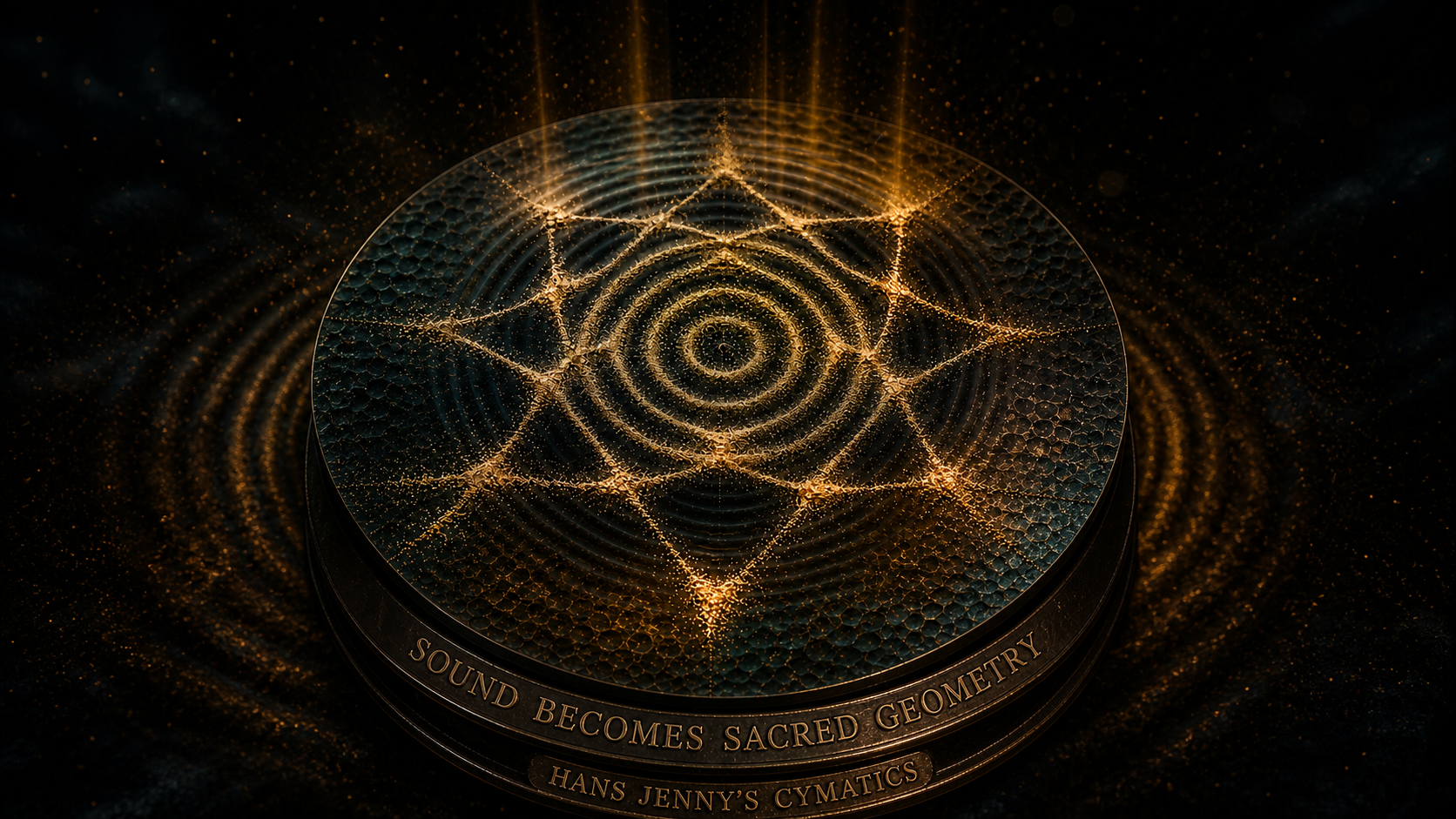
Hans Jenny's vibrating plate did more than make sand dance — it introduced frequency, medium, and form as one continuum. How cymatics turns the Codex into a language you can actually hear, test, and read.
Vibration does not simply move things. It organizes them. When the right frequency passes through a medium, the medium resolves into regular patterns of form. Those patterns repeat, they persist, and they correspond to their own cause. This essay argues that such correspondence is a language, that visible form is its grammar, and that the vibrating plate is a dictionary the Codex can read, and test.
The same transmission is published as a paired study on Vault of Arcana and Universal Transmissions. The two pages are one article: a reader can move from the Scroll's archive context into the live experiments without losing the thread.
Prologue: The Plate That Tried to Speak
In the middle of the twentieth century, a Swiss physician fastened a thin metal plate to an oscillator and scattered sand across its surface. When the plate vibrated, the sand did not stay put. It crept into fixed and orderly figures: circles became polygons, flat surfaces grew flowering symmetries. The sand was not obeying the motion of the plate so much as writing it down.
The physician was Hans Jenny, and he gave his work a name: cymatics, the study of wave phenomena and of the forms they make visible.[1] His modest plate became a working proof that sound, which we usually hear and then forget, also has geometry. Every frequency drew its own map, and every map was steady and repeatable for as long as the frequency held still.[1]
He dedicated a book to that one idea. He wrote, "To the Sound which unifies all phenomena, generating the vast world of form," and he closed the dedication by calling it a world created "in its 'triadic' nature."[1] He returned to that word again and again. Vibration, he insisted, always shows itself in three joined aspects: the frequency, the wave, and the resolved form. It is a trinity, and it is also the closest thing we have to a machine that tries to speak. The plate answered in geometry, and it spoke a patient and legible dialect.
One: What Jenny Actually Showed
Jenny's central claim was careful and humble. A vibration presents itself, he said, in three aspects that never separate. The first is frequency, the rate or character of the wave. The second is the wave itself moving through a medium such as air, water, or the body of a plate. The third is the resolved form that becomes visible when the wave settles. These three work together. None of them, alone, is the whole of what a sound is.
The valuable fact is that this triadic structure is not a metaphor. In a cymatic experiment, the same frequency run through the same medium produces the same form. The form matches its frequency the way a signature matches a hand. That correspondence is not poetic: it is reproducible, and reproducibility is what turns a metaphor into a method.[1]
Hold this boundary in mind. One person says that sound is like language. Another shows that a fixed sound fixes a fixed form, once, again, and again. A metaphor only describes. A method can be repeated, can be predicted, and can be tested for correctness. The moment a vibration reliably yields a shape that any observer can recover, we have crossed from simile into procedure.
Cymatics makes no spiritual claim by itself. It offers a repeatable observation, and that repetition is the source of its power. It lets us treat visible form as an answer to a fixed input, and it invites the next question: if pattern is produced from input, could the pattern be read backwards, restoring the input from its marks? That backwards reading is the language.
Two: The Body Is the Plate
Jenny's equipment was not arbitrary. He pressed an oscillator against a plate, and he pointed out that the living body responds the same way. The plate, in his words, amplifies the vibrations of the oscillator, just as bones amplify the vibrations of a voice.[1] The body is a cymatic surface: it receives, it conducts, and it shapes.
A very old esoteric teaching states a general law and calls it the Principle of Vibration. Nothing rests, it says; everything moves; everything vibrates.[3] If every material has a ruling rate, then the body is not a dead weight. It is an active, continuous instrument, a plate that is tuned and always waiting for a matching tone.
The old texts were also honest about secrecy. The Picatrix, the great sourcebook of the planetary tradition, says that this science has been hidden by its philosophers and phrased in secret words, in signs and in similitudes.[2] Read plainly, this is not a wall against the curious. It is a report on how the knowledge is stored. The hidden science lives in signs and visible figures, and there is no more natural way to keep a science of visible form than to speak it through forms themselves.
So the body becomes an instrument of transduction. It accepts a tone, carries it through tissue the way a plate carries a wave, and resolves it into a visible or felt state. The same chain runs out to the page, to a sheet of water, to a bowl. Wave imports from an oscillator into a medium and exits as shape. That transduction is the whole engine of cymatics, and a human life is one more medium through which the wave travels.
Three: Form Is a Grammar
Spread a set of cymatic images in front of you and certain shapes keep returning: triangles, squares, hexagons, rings, spirals. These are the recurring attractors of resolved form. They are few, they are stable, and they are easy to recognize. Because they reappear across frequencies and across materials, they behave less like accidents and more like a vocabulary. A set of fixed, repeatable marks is only a step away from a language.
Others have asked whether these recurring shapes could be letters. That is a useful proposal, but it is not proof. If the repeating figures are letters, the plate holds a lexicon with a small set of characters, and grammar supplies the rules that join them into wholes. The proposal earns its place only when the characters remain stable across controlled runs.
The Codex is, in this view, a universal alphabetical table: a named catalog of patterns, a willingness to let a made shape stand for a sign. It does not claim to exhaust the alphabet of creation. It claims only that a table can be built and consulted, compared, and tested. When a plate reliably yields a hexagon at a certain tone, and that event is logged, the Codex has registered a letter. For a compact visual companion to this method, the Correspondence Codex Companion PDF gathers reference pages for geometry, astrology, alchemy, and symbolic correspondence.
Let the alphabet earn its name. A letter is a letter only if it is consistent. If a tone sometimes gives a triangle and sometimes a spiral, it is noise, not a sign. The whole dignity of the grammar comes from its patience and its consistency. Run the plates, keep the records, and let the marks sort themselves into an alphabet, guided by an instrument that turns a voice into a drawn letter.
Four: From Tonoscope to Codex
This is not a fictional plan. A live site has already begun to build it. The platform hosts the Cymatic Tonoscope — an interactive experience that turns sound into visible form — along with the Cymatic 3D experiment, which gives that form volume in space. It also hosts the Correspondence Continuum and the Correspondence Codex, the pairings tables that join a sign to its meaning, and the Oracle, which answers a question with a line drawn from that same table. The whole body of correspondences is set out in the Codex volume.
These operate as one methodical chain, not as four separate attractions. The tonoscope lets a voice become a visible line. The 3D canvas lets the line move in space. The Correspondence Continuum holds the link between a mark and a meaning, and the Oracle returns an answer from that same table. Alone, each route is a demonstration. Taken in order, they are a pipeline from voice, through form, into reading.
A curious visitor can use the site as a small predictive system. Send a tone into the tonoscope and watch what appears. Then visit the Correspondence Continuum and ask what that shape means. Where the two agree, the route is behaving as a method. Where they disagree, note the disagreement, log it, and let that too be evidence. Either way, the chain is being exercised.
There is no need to overstate the maturity here. These experiences are the seed of a method, not a finished peer-reviewed instrument. But a method is built from working parts. The care that matters is that each live route stays open, repeatable, and anchored to the Codex, and that is what turns a gallery into a machinery for correspondence.
The Test of a Letter
A careful reader now raises the hardest question. If a triangle can mean a thousand things in a thousand traditions, how can any letter map be called true? How does one triangle carry one meaning?
The answer does not live in the honesty of the triangle. It lives in the consistency of the system that uses it. A mark becomes a letter when its use inside a code is fixed. Consider three simple propositions:
- A letter map is credible when a stable form reliably and consistently follows a fixed tone.
- A letter map communicates when the relation between a sign and its meaning is fixed, declared, and public.
- A letter map is useful when its predictions can be checked, and when any claimed match can be shown to fail.
A bare triangle is decoration. A triangle bound in the Correspondence Continuum, tied by a written rule to a meaning, is a letter. The test is not whether the triangle unlocks a secret. The test is whether the Codex behaves as a code: the same sign produces the same value every time, and any reader can verify it. That test is plain, public, and repeatable, and it is the test the site is built to pass.
Secrecy, in the honest sense that the old texts teach, does not forbid a published result. It guards a private method of inquiry, but it does not refuse to publish its findings. The test is therefore a friend. It keeps the Codex from hiding behind authority and makes it answer to procedure.
A Method, Not a Metaphor
Here is a plain working order. Each step can be done by a careful person with modest tools, and each step should be written down.
First, inventory the corpus. Bring together the Codex's documents and lists into one map so that everyone knows the full range of characters it claims.
Second, set a finite set of phonemes. A phoneme is a basic unit of sound. Choose a manageable collection, agree on it in advance, and do not change the list in the middle of the run.
Third, run each phoneme through a tonoscope across one or several octaves, and record the waveform and the visible shape that each produces.
Fourth, compare each produced shape to the nearest form in the Codex. The comparison must be explicit. Where it matches, log a positive; where it differs, log the difference.
Fifth, keep a public, repeatable registry that records the phoneme, the frequency, the cymatic image, the Codex entry, and the result. Its one job is that another set of hands can run the same test and reach the same result. Publicity is not decoration; it is the honesty that makes a method an instrument.
The method does not promise a finished science overnight. It promises a way to ask. Every trial either confirms a letter or corrects it. That is a sturdy way to proceed.
The Honest Line
Cymatics gives us a clean boundary. A fixed setup can produce a repeatable mark; it cannot by itself prove that the mark carries a spiritual meaning. Traditions may read sound, geometry, or the body as signs, but those readings remain interpretations until their terms are stated and their results can be checked.
That boundary is not a dismissal of tradition. It is a way to read tradition without asking it to do the work of an experiment. The Picatrix can teach us how a premodern system organized correspondence, while The Kybalion can show how a modern Hermetic revival framed vibration.[2][3] Neither text replaces a controlled observation of a plate. The responsible reader keeps the layers distinct: source, interpretation, experiment, result.
The power of cymatics does not come from faith. It comes from an image you can send, that you can see, and that you can check.
Why It Matters
Whether form is a language is more than a matter of catalog. It changes how we read old books. If the body is a plate, and form is a grammar, then the ancient pages that describe the world in terms of vibration are not superstitions; they are early descriptions of a real thing, the same thing that a plate shows. And we can touch that plate.
It matters for anyone who speaks and listens. When a person speaks, they set a plate in motion — the glass, the water, the air around them — and the effect is real. A word carries a form, and a form can be seen in the things it builds. That is not mystery; it is vibration producing its shape, and the shape is a message. The mystery we remove is the false one. What remains is a set of laws and the invitation to study them.
Finally, it matters that you are the ear. A frequency means nothing without an instrument to hear it, and the Codex is exactly such an instrument. You are the ear that hears the plate, you are the mind that reads the tables, and you are the judge that decides whether a sign and a value agree. The method relies as much on your attention as it does on the tone.
Conclusion
Let me state the claim and hold it clearly. Form has a grammar, and that grammar is regular and documented. Sound is the grammar's vocabulary, the common carrier of tone. The vibrating plate is its dictionary, the visible record that joins a sound to a shape. These three aspects are not three separate things but one continuous operation, and together they can be tested.
The Codex becomes an instrument when it can test itself. It runs a tone, waits for the form, consults its own table, and reports the result. An instrument built like this is no longer a lore; it is a way of reasoning, open to the public and able to answer. The laws of form and of sound, which the tradition has guarded for generations, can at last settle on a plate and be examined by the ear of anyone who comes close.
We are asked to do one thing: trust but verify, listen but publish. What vibration shapes in sand, the same wave writes on the page. The plate is speaking its language, and the Codex is keeping the log. The plain task is to learn to read what falls on the plate, to write down the important letters, and never to close the book — because the plate tried to speak, and we are only now teaching it to spell.
When the same tone produces the same form, and the same form carries the same meaning, then the language is real. Listen, measure, keep the record open, and let the shape, at last, hold its letters out to you.
Sources
[1] https://archive.org/details/Cymatics — Hans Jenny, Cymatics: A Study of Wave Phenomena and Vibration. [2] https://archive.org/stream/the-Picatrix-Liber-Rubeus-Edition-Greer-and-Warnock/the-Picatrix-Liber-Rubeus-Edition-Greer-and-Warnock_djvu.txt — Picatrix, Liber Rubeus Edition, translated and annotated by John Michael Greer and Christopher Warnock. [3] https://archive.org/details/Kybalion1908 — The Kybalion: A Study of the Hermetic Philosophy of Ancient Egypt and Greece (1908), Three Initiates.
Continue the Study in the Vault
If you want a concrete visual table to keep beside the experiment, begin with the Correspondence Codex Companion PDF and then explore the Sacred Geometry Master Collection. The article's live experiments remain available through the Cymatic Tonoscope and the Correspondence Continuum.
Continue the vibrating-plate method into a visual correspondence archive — sacred geometry, symbolic reference pages, and the Codex's working alphabet.