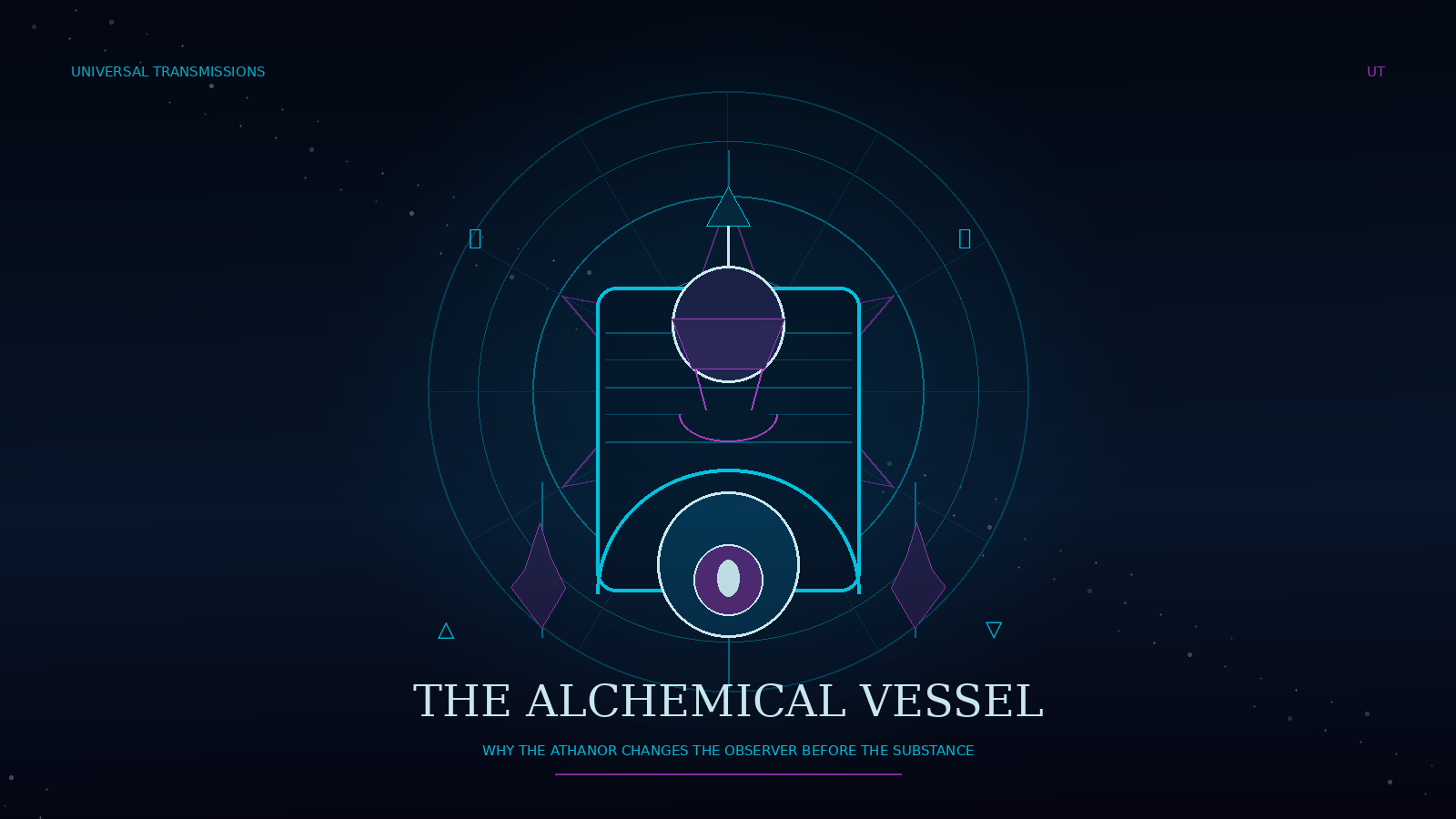
The athanor is not primarily an image of heat. It is a technology of sustained attention: a vessel that holds unstable material, time, and contradiction long enough for transformation to become legible — changing the observer before it changes the substance.
Layer 1: The Human Anchor
The furnace is not the work
Alchemy is usually introduced through its most theatrical promise: lead becoming gold, a philosopher’s stone, an elixir, a final operation in which matter reveals the divinity hidden inside it. That promise is memorable because it is dramatic. It is also a poor place to begin.
Begin instead with the vessel.
Before the material is named, before the colours are interpreted, before the operator announces a result, something has to hold the work. A crucible, retort, alembic, egg, flask, jar, or furnace is not a neutral container waiting for a clever person to use it. In the alchemical imagination, the boundary around a process is one of the process’s active conditions. The vessel controls exposure. The furnace controls tempo. The seal controls when the operator is allowed to look. Together they establish a small world in which unstable things can remain in relation long enough to change.
That is the thesis of this essay: the athanor is not primarily an image of heat; it is a technology of sustained attention. It changes the observer before it changes the substance.
The claim is historical before it is psychological. Alchemical texts repeatedly make the apparatus, the timing, the materials, and the qualifications of the operator part of one grammar. Later readers turned that grammar inward, treating the furnace as a figure for the body, the psyche, or the spiritual life. That inward turn can become sentimental if it forgets the laboratory. It becomes useful when it preserves the laboratory’s discipline: define the boundary, regulate the heat, resist premature interpretation, and let a transformation complete enough of its cycle to be seen.
This is not a recipe. Do not reproduce historical chemical operations from an essay, and do not treat a symbolic reading as medical or scientific advice. The value of the vessel is not that it gives us a shortcut to transmutation. Its value is that it gives us a severe question: what are you trying to change while refusing to create the conditions in which change could occur?
For the stage-by-stage map of the Great Work, see The Alchemy of the Soul. This scroll takes a different route. It asks why the stage exists at all: what makes a sequence of operations possible, and why the container is part of the meaning.
Athenor, athanor, and the difference a boundary makes
The general word is usually written athanor: an oven designed to maintain a steady heat for a long period. Fulcanelli’s English text uses the spelling athenor and gives the term a specifically architectural and initiatory charge. Looking at the towers and porches of French cathedrals, Fulcanelli reads the building as a disguised laboratory diagram. In one passage, the tower is described as an occult furnace with “two flames—potential and actual” [1]. In another, the athenor at Notre-Dame is read as “a tower raised on arches,” whose “ash box, the tower and the dome” preserve the constituent parts of the alchemical furnace [1].
We do not have to accept Fulcanelli’s interpretations as historical proof about the intentions of medieval builders. His book is a twentieth-century esoteric reading of architecture, and it should be read as such. But the passage makes a precise conceptual move: it does not represent the furnace as a burst of fire. It represents the furnace as a structure. Fire is only one element. The ash box receives what falls away. The tower establishes an interior. The dome closes and completes the image. A working furnace is a choreography of containment.
That choreography is easy to miss in modern descriptions of transformation. We talk about breakthrough, ignition, acceleration, disruption, scale. We praise the flash because the flash is visible. The athanor asks us to attend to the less marketable conditions: insulation, repetition, maintenance, a controlled range, and a material that is not allowed to escape every time it becomes uncomfortable.
The vessel is therefore a temporal instrument. It does not merely hold a thing in space; it holds a thing in duration. A stable boundary allows the operator to distinguish a phase from a failure, a slow change from a dead end, and a necessary obscurity from a visible result. Without duration, every intermediate state looks like a verdict.
The sealed vessel is an argument about knowledge
The Picatrix, read here through the Greer and Warnock edition, is often approached as a catalogue of astrological and magical operations. Its more revealing lesson for this essay is grammatical. When the text describes a material operation, it specifies the relation among vessel, seal, fire, and time. One passage says a mixture should be “sealed up with alchemists’ luting; and put it on a gentle fire” [3]. Another instructs that a preparation be placed in an earthenware vessel “of appropriate size” and sealed before it is put on the fire [3].
The historical recipes are not instructions to copy. They belong to a dangerous and technically specific world; some include toxic substances and procedures that require specialist equipment. For a modern historical account that keeps alchemy in its laboratory and intellectual context, see Lawrence M. Principe’s The Secrets of Alchemy [4]. What matters here is the order of attention. The text does not say: have an idea, apply force, and demand a result. It says, in effect: choose a vessel proportionate to the work, close the boundary, and modulate the heat.
That order is a theory of transformation. “Appropriate size” means the container is neither an afterthought nor an arbitrary stage prop. A vessel too small cannot accommodate expansion; a vessel too large loses the relation that makes the operation legible. The seal is not a mystical decoration. It marks a limit on exchange. Gentle fire is not weak fire. It is fire calibrated to duration rather than spectacle.
The alchemical vessel is thus a small ethics of proportion. It asks three questions before the operation begins:
- What must be held together long enough to teach me something?
- What must be kept out so the process is not constantly reset?
- What intensity can be sustained without destroying the relation I am trying to study?
These questions apply well beyond a laboratory. A conversation can be a vessel if it has enough trust and enough boundary to let a difficult truth remain present. A studio practice can be a vessel if unfinished work is protected from the demand to become content immediately. A research project can be a vessel if the question is held steady long enough for disconfirming evidence to arrive. In each case, containment is not control over the outcome. It is protection for the conditions under which an outcome can become knowable.
Layer 2: The Silicon Synthesis
The operator is part of the apparatus
The modern fantasy of an objective instrument imagines a machine that produces the same result for anyone who presses the right button. Alchemical texts often make a stranger claim: the operator changes the experiment.
Manly P. Hall’s The Secret Teachings of All Ages is a later occult compendium, not a neutral historical manual. Its rhetoric is nevertheless useful because it makes the operator’s interior state explicit. Hall writes that the alchemical retort symbolizes the womb and that its deeper meaning lies in “the allegory of the second birth” [2]. He then makes the stronger claim that “unless the greater alchemy has first taken place within the soul of man, he cannot perform the lesser alchemy in the retort” [2].
Taken literally, this is not a testable rule of chemistry. Taken as a statement about interpretation, it is exact: an instrument does not decide what counts as a meaningful result without a human frame around it. The operator brings expectation, impatience, fear, training, and desire into the room. Two people can look at the same darkening liquid and see a stage, a failure, or an excuse to start again. The apparatus is material, but the experiment is also perceptual.
This is where the vessel changes the observer. A sealed process removes the little rewards that keep an impatient mind alive. There is no constant confirmation. There is only the task of maintaining the condition and waiting for the proper interval. The operator learns that attention is not the same as inspection. Inspection asks, “Has it worked yet?” Attention asks, “What is the process doing, and what am I doing to the process by needing an answer now?”
The distinction matters in the age of automated systems. A model, dashboard, archive, or instrument can produce a stream of outputs, but an output is not yet knowledge. The person who changes the prompt every few seconds may generate novelty without learning the behaviour of the system. The artist who revises a work before its tensions become visible may polish away the information carried by the unresolved form. The researcher who stops when the data confirms a preference has mistaken a warm room for a reliable furnace.
A vessel creates a commitment to a protocol. It says: we will not change every variable simply because the current state is uncomfortable. We will record what happened. We will distinguish an observation from a wish. We will allow the material to answer in a language that is slower than our appetite for certainty.
Containment is not repression
There is a danger in praising the sealed vessel too quickly. A boundary can protect a process, but it can also become a prison. Psychological language makes this especially clear. “Contain your feelings” can mean “give an emotion a safe form and enough time to be understood.” It can also mean “make the emotion invisible so nobody has to respond to it.” Those are not the same operation.
The alchemical vessel is not a command to suppress. It is a condition for metabolizing. What is held must continue to move. The work includes circulation between volatile and fixed, ascent and descent, heat and rest, dissolution and re-formation. A sealed vessel that cannot exchange anything is not a living process; it is a dead archive.
This is why the image of a womb is both powerful and limited. It names a protected interval in which a form develops away from public demand. But it can mislead if it turns transformation into passive waiting. An athanor requires maintenance. The fire is regulated. The vessel is inspected at the right time. Residue is separated. The operator must decide when a phase has ended and when opening it would only interrupt digestion.
A useful modern translation is not “hide until you become perfect.” It is “build a container in which feedback can arrive without forcing premature performance.” A daily writing practice, a therapy appointment, a laboratory notebook, a long conversation, a quiet studio, a retreat with a clear return date: each can become a vessel when it protects honest contact with material while preserving a route back into relationship.
The body as athanor: a corpus note
The Vault’s indexed corpus adds a distinctly modern esoteric usage. In the Law of One material, the athanor is glossed as “an oven; a fire; a digesting furnace” designed to maintain a uniform and constant heat. The same passage describes the body as an athanor through which the alchemist manifests gold. The public home for that material is the L/L Research Law of One library [5].
This is not evidence that an ancient alchemical manual taught the same doctrine. It is evidence of a later transmission adapting an older image. The body becomes the vessel because the body is where time, sensation, memory, and consequence meet. It is not an abstract mind floating above conditions. It is an instrument that gets tired, hungry, stimulated, injured, and repaired. Any spirituality that treats the body as disposable has already broken its athanor.
The corpus image is helpful precisely when it is kept concrete. To call the body an oven is not to claim that a human being is literally a furnace in a medical sense. It is to notice that experience is digested. Sleep, repetition, breath, food, movement, grief, and attention change what can be integrated. A realization that never reaches behaviour has not yet been fixed. A practice that produces grand language while degrading the body is not a successful transmutation; it is an uncontrolled burn.
This gives the thesis a second edge: the observer is not outside the vessel because the observer is made of conditions. You do not bring a pure witness to the work. You bring a nervous system, a history, a social field, and a body that is continuously translating the world. The discipline is not to escape those conditions, but to make them visible enough that they can participate without secretly governing the operation.
The archive as a vessel
A digital archive can either deepen this discipline or destroy it. An archive that presents ten thousand texts as an endless feed invites collection without digestion. An archive arranged around questions, correspondences, and return paths can become a vessel for study.
That difference is editorial, not technological. The file count is not the work. The work begins when a reader chooses a bounded question and lets several texts remain in dialogue. Fulcanelli’s cathedral, Hall’s retort, the Picatrix’s seal, Principe’s modern history, and the corpus’s body-as-athanor are not interchangeable authorities. They are different layers of a tradition: a modern symbolic reading, a twentieth-century occult synthesis, a medieval magical text in translation, a historian’s corrective, and a later esoteric adaptation.
Reading them together does not prove that all alchemy secretly meant one thing. It lets us observe how the vessel migrates. In one text it is a furnace. In another it is a womb. In another it is a sealed earthenware container. In a later corpus it is the body. The continuity is not a single doctrine but a recurring problem: how can a volatile relation be held without either freezing it or losing it?
For readers who want to study those layers rather than consume a summary, the 21GB Alchemy Vault and the Hermetic Alchemy Master Archive are optional research paths. They are libraries, not guarantees of truth. Use them as a shelf you can return to, not as a substitute for reading, attribution, or discernment.
Layer 3: Open Inquiry & Practice
Four ways to build a vessel without pretending to be an alchemist
The athanor becomes useful in contemporary life when it produces better questions and better habits, not when it decorates ordinary ambition with occult vocabulary. The following is a contemplative translation, not a historical laboratory procedure.
1. Name the material before naming the result
A transformation cannot be observed if the starting condition is mythology. Write down what is actually present: a recurring conflict, an unfinished body of work, a decision with competing values, a research question, a pattern of attention. Do not call it “my shadow” if you have not described what happened. Do not call it “alignment” if you cannot say what changed in behaviour.
Alchemy’s language is dramatic because it keeps contact with process. Nigredo is not simply “a bad mood.” It is the recognition that a former arrangement has become unable to carry the work. The vessel begins when the material is described without immediately converting it into an inspirational story.
2. Choose a boundary that protects contact, not comfort
A useful boundary should make honest observation easier. It might be a two-week notebook, a weekly studio appointment, a conversation with a defined question, or a research folder with a fixed set of sources. The boundary should be clear enough that you can tell when you have kept it and porous enough that new evidence can enter.
This is the difference between a vessel and an identity. “I am an alchemist” is an identity. “For the next fourteen days I will return to this question before I publish an answer” is a vessel. One flatters the observer; the other changes the observer.
3. Regulate intensity instead of worshipping it
The culture of breakthrough confuses heat with speed. More stimulation is not necessarily more transformation. A sustainable practice includes intervals of effort and intervals in which the material can settle. It also includes a way to notice when intensity is becoming compulsion: lost sleep, narrowed attention, disregard for ordinary responsibilities, or the belief that a symbolic interpretation excuses harm.
A gentle fire is not a timid life. It is a life whose energy is made repeatable. If the work cannot survive a night’s sleep, a meal, a walk, or a conversation with someone outside the system, it may be an excitation rather than an integration.
4. Open the vessel with evidence in hand
At some point, containment becomes avoidance. The vessel must open. When it does, carry records rather than revelations: what you tried, what repeated, what failed, what another person observed, and what changed outside your private interpretation. The point of the opening is not to announce that the material has become gold. It is to test whether the claimed transformation travels.
A result that exists only inside the language used to produce it is still a hypothesis. A result that changes how you listen, make, repair, decide, or care has entered a wider world. Projection, in this modest sense, is not magical domination of matter. It is the moment a metabolized insight becomes accountable in relationship.
What the athanor refuses
The vessel refuses three shortcuts.
It refuses instant meaning. A symbol can be beautiful before it is understood. An image can be numinous and still be wrong about the world. The vessel protects the interval in which attraction can be tested.
It refuses disembodied mastery. No amount of textual fluency compensates for a practice that makes the practitioner less honest, less rested, less capable of repair. If the gold requires somebody else to become the ash, the operation has failed ethically.
It refuses unbounded accumulation. More books, more correspondences, more tools, and more signals do not automatically produce a stronger vessel. Sometimes the next operation is subtraction: one question, one source, one promise kept long enough to reveal its consequences.
These refusals are why the vessel is a better emblem for inner work than the stone. The stone suggests a finished object that can be possessed. The vessel remains relational. It needs a material, a heat, a duration, an operator, and a world to which the result can return.
FAQ: the athanor in plain language
What is an athanor?
An athanor is an alchemical furnace designed, in the traditional description, to maintain steady heat over time. In this essay it also names the wider arrangement of vessel, boundary, duration, and attention that makes a slow transformation observable.
Is the athanor a literal furnace or a psychological symbol?
Both readings exist, but they should not be collapsed. Historical alchemical work involved real materials and apparatus. Later authors used the furnace as a figure for the body, soul, or inner development. The strongest reading keeps the material history and the symbolic migration in dialogue.
How is this different from the twelve stages of the Magnum Opus?
The twelve-stage map describes operations and phases. This essay asks what makes any sequence possible: a vessel, regulated heat, an interval of concealment, and an operator willing to wait without inventing a result. It is about the conditions of transformation rather than another list of stages.
Does “containment” mean suppressing emotions?
No. Containment means giving experience a safe, bounded form in which it can be felt, described, and metabolized. Suppression makes experience invisible; containment makes it available for honest contact and eventual integration.
Can I use this as a practical alchemy recipe?
No. Do not attempt historical chemical operations from symbolic writing. Use the framework as a reflective model for bounded study, creative practice, or self-observation, and seek qualified professional help for medical, psychological, or chemical concerns.
The vessel that reads us back
The alchemist’s most important instrument may be the one that makes impatience visible. In front of a sealed vessel, the observer discovers how often they want to open the process, rename the material, increase the heat, or declare the result. The apparatus does not merely transform what is inside it. It returns the operator’s habits in amplified form.
That is why the athanor changes the observer first. It takes the fantasy of transformation as an event and turns it into a relationship with duration. It asks for a boundary strong enough to protect uncertainty and porous enough to receive evidence. It makes the body part of the method. It turns an archive from a pile into a practice. It lets a symbol remain beautiful without allowing beauty to become proof.
The final question is not, “How do I make gold?” It is: what would I have to hold steadily enough that I could finally tell the difference between change and the story I tell about change?
Read the paired Vault of Arcana scroll, The Alchemical Vessel: Why the Athanor Changes the Observer Before It Changes the Substance, as the source-side companion to this transmission.
Continue the visual and conceptual transmission in the Universal Transmissions mirror, then return to the Vault’s Alchemy archives when you are ready to read the sources in greater depth.
Sources
[1] https://archive.org/details/fulcanelli-the-mystery-of-the-cathedrals > "The constituent parts of the alchemical furnace may be recognized in it; the ash box, the tower and the dome." > "We have seen how, at Notre Dame of Paris, the athenor takes precisely this form of a tower raised on arches." [2] https://archive.org/details/TheSecretTeachingsOfAllAges > "While it is quite true that the alchemical retort symbolizes the womb, it also has a far more significant meaning concealed under the allegory of the second birth." > "Unless the greater alchemy has first taken place within the soul of man, he cannot perform the lesser alchemy in the retort." [3] https://archive.org/details/the-Picatrix-Liber-Rubeus-Edition-Greer-and-Warnock > "which should be sealed up with alchemists’ luting; and put it on a gentle fire." > "Let it all be put into an earthenware vessel of appropriate size, and sealed well with alchemist’s luting." [4] https://archive.org/details/secretsofalchemy0000prin > "The secrets of alchemy" [5] https://www.llresearch.org/library/the-law-of-one — L/L Research — The Law of One library > "The Law of One"
By Prime + Hakan
Related Transmissions
Sep 8, 2026
The Hermetic Crater: The Cup of Mind and the Discipline of Receiving
20 min
Aug 30, 2026
The Rosicrucian Manifestos: How a Secret Brotherhood Turned Absence into a Method of Reform
21 min
Aug 20, 2026
The Picatrix and the Technology of Correspondence: How Medieval Magic Turned the Sky into an Instrument
12 min
Read the athanor, retort, and sealed vessel in a deeper primary-source archive — alchemical manuscripts, Hermetic texts, and the traditions of the Great Work.