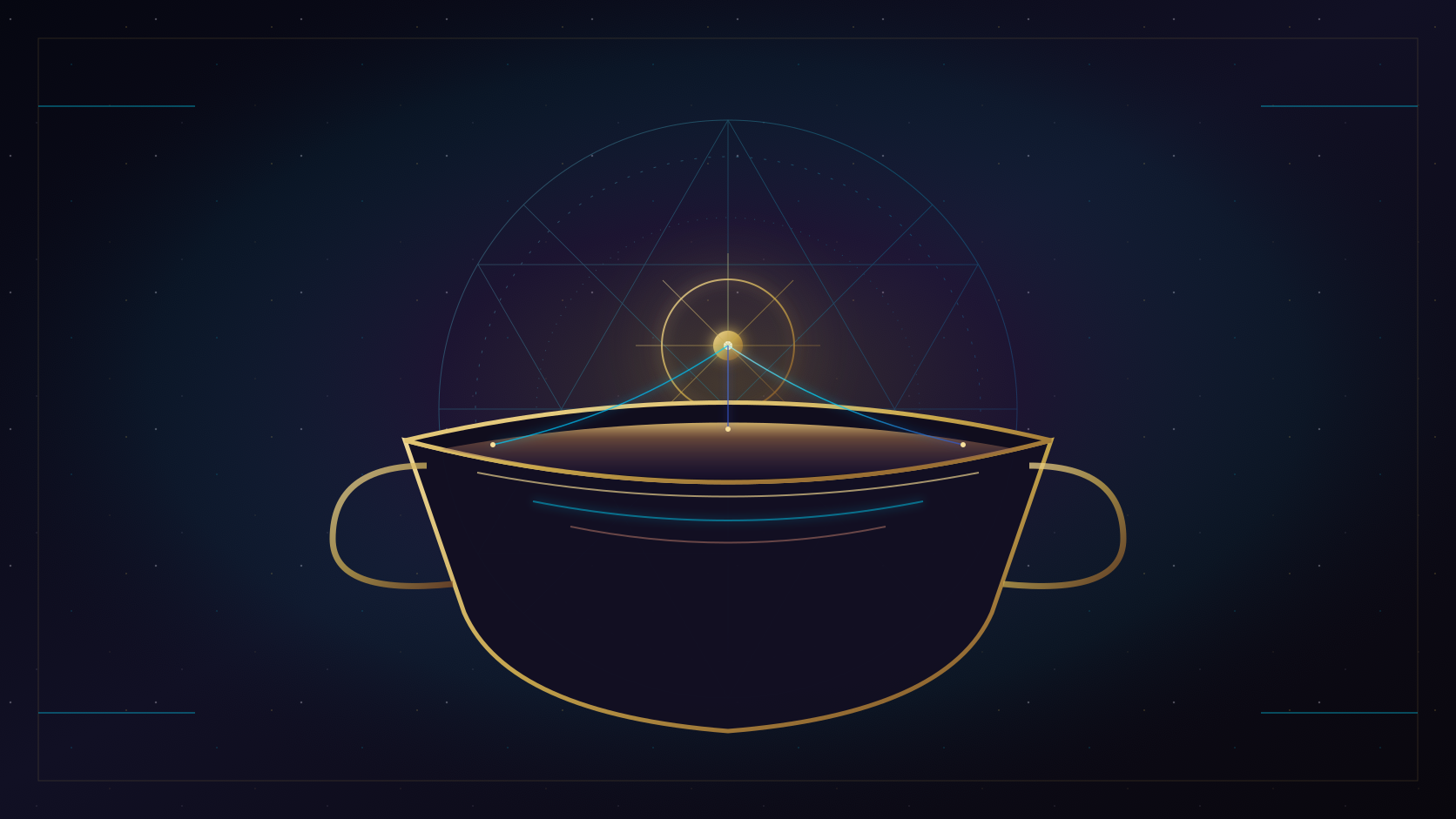
The Hermetic crater is not a container of secret information. In Corpus Hermeticum IV, Mind is placed between souls in a mixing-bowl: a vessel that asks the receiver to enter, change proportion, and return with a form of life rather than another fact.
The vessel is not where wisdom is stored. It is where the reader is changed.
The Vault of Arcana companion essay keeps the historical and textual question in the foreground. This Universal Transmissions transmission takes the same image into the studio, the archive, and the problem of building things that can follow a signal without understanding its purpose.
Every archive has a rim.
You can stand at it and count the files. You can photograph the shelves, catalogue the symbols, sort the fragments by century, and still never enter the thing you came to study. The information remains outside you, arranged and available. The arrangement may even become a new identity: the person who knows the names, owns the books, recognizes the correspondences.
The fourth treatise of the Corpus Hermeticum puts a harder image in front of that habit. Tat asks Hermes why God has given reasoned speech to everyone but not Mind. Hermes does not answer with a hierarchy of IQ, bloodline, education, or permission. He says that Mind was placed “between souls” as a prize, then filled into a great vessel and sent down with a herald.
The herald’s call is not “learn the password.” It is closer to this: enter the vessel if your heart has the strength; if you believe you can return to the one who sent it; if you recognize the reason for which you came into being.
The image is usually called the Cup, but the Greek term is kratēr: a mixing-bowl. That noun changes the signal. A cup can be consumed. A mixing-bowl is a process. It is where separate things are brought together under a measure before they are distributed.
This is the working thesis of the transmission: Hermetic Mind is not an object passed from a divine storehouse into a human head. It is the new proportion that appears when the receiver enters the medium. Gnosis is not what you possess after the download. It is what your way of seeing and making can now hold together.
Read the text before making it a mood
The Corpus Hermeticum is a collection, not a single signed volume from a historical author named Hermes. Its Greek treatises emerged in the mixed intellectual and religious world of Roman Egypt, generally dated across the middle of the first to the end of the third century CE. The Encyclopaedia Britannica account of the Hermetic writings describes a body of revelatory dialogues shaped by Greek philosophy and Egyptian religious settings, including Platonic, Stoic, and Neopythagorean currents.
That does not make the text less strange. It makes the strangeness more precise. We are not looking at a modern self-help diagram that has been projected backward into antiquity. We are looking at a dialogue in which cosmology, instruction, ascetic warning, and metaphysical argument are layered together.
For modern scholarship, the stable reference is Brian P. Copenhaver’s Hermetica, the Cambridge translation of the Greek Corpus Hermeticum and the Latin Asclepius. The Cambridge record for Corpus Hermeticum IV identifies the chapter and its editor; the chapter’s DOI is 10.1017/CBO9781107050075.007. G. R. S. Mead’s older translation is available through the Internet Sacred Text Archive and the Gnostic Society Library.
The translations do not give us one frictionless English object. Mead’s title is “The Cup or Monad” and his invitation uses the word “baptize.” Copenhaver’s title is commonly rendered “The Mixing-Bowl or Monad.” The difference is not cosmetic. “Cup” brings communion and personal drinking to the front. “Mixing-bowl” restores the vessel’s work. “Baptize” makes immersion ritual-shaped. “Immerse” leaves the historical question open.
A good reading does not choose whichever word best confirms a prior worldview. It compares the instruments.
The kratēr is a technology of proportion
A krater was an ancient Greek vessel used for diluting wine with water. It was broad, stable, and made for mixing before the drink was distributed. It belonged to a social setting in which the strength of the wine was not an incidental detail. The mixture had to be prepared.
The material context does not prove that the Hermetic dialogue records a literal symposium or an institution that performed a crater baptism. It gives the metaphor a physical intelligence. The thing in the scene is not just a precious container. It is an instrument that changes a relation.
This matters because the most common modern fantasy about spiritual knowledge is acquisition. We imagine a hidden substance, a lost code, or a rare frequency that can be transferred intact from archive to seeker. The receiver stays fundamentally the same and simply has more inside.
The mixing-bowl refuses that fantasy. If the seeker enters it, then the seeker becomes part of the mixture. The body, appetite, language, memory, fear, and unfinished motives do not vanish at the rim. They bring their own concentration. Mind is not poured into an empty container; the existing composition is exposed to another measure.
The vessel performs three operations:
- It holds. Separate elements need a boundary before they can be related. Without a vessel, mixture is only spillage.
- It changes proportion. What enters with too much intensity can be brought into relation with something that makes it usable. The problem is not that desire exists; the problem is that one desire claims to be the whole field.
- It distributes. The contents of a mixing-bowl are prepared for movement outward. Mind is not a private ornament. What has been received must become intelligible in relation, speech, and action.
This is why “enter the bowl” is more demanding than “read the book.” Reading can leave the reader’s composition untouched. Entering means allowing the text to become an active medium.
Mind is not a larger inventory
In the dialogue, logos is distributed among all people while nous is set in the middle “as a prize.” The distinction is not a modern measurement of intelligence. It is a distinction between having language and being oriented by a deeper intelligence.
A person can produce reasons for everything and still be unable to recognize what a life is for. A person can remember an enormous number of facts and remain governed by every passing appetite. The text’s “speech without Mind” is not stupidity. It is competence without orientation.
Nous is usually translated as Mind or intellect, but its meaning in the chapter is established by its actions. Mind is tied to contemplation, wonder, knowledge of origin, recognition of the maker, and the possibility of becoming a participant in gnosis. It is not the same thing as IQ, productivity, or the ability to win an argument.
That is also why the “prize” cannot be treated as a rank granted by an occult elite. The chapter repeatedly uses verbs of hearing and choosing. The person is addressed. The herald makes a proclamation. The heart either has the strength to enter or remains outside. The gift is divine, but participation is not automatic.
Three movements make the distinction clearer:
From having to receiving
Having keeps the object at a distance. Receiving admits that the object can change the receiver. A person who receives a teaching may discover that the old arrangement of motives no longer works.
From knowing about to knowing for
The herald asks whether the hearer knows for what they came into being. This is not a request for a job description from heaven. It is a demand that information acquire direction. What is the knowledge for? What does it make possible?
From display to contemplation
The Hermetic human is described as a spectator of divine works, someone who wonders and recognizes. Contemplation is not passive scrolling. It is sustained contact in which the thing seen becomes more real than the reflex to classify it.
The difference is visible in any serious practice. A person can collect references to sacred geometry without learning how a line controls the tension of a composition. A person can quote alchemical stages without staying with the material problem that makes transformation slow. A person can recite the names of planets, gods, and principles without allowing any of them to interrupt a borrowed objective.
The archive is the rim. Practice is the immersion.
The herald’s call is a readiness test
The text does not give us a securely identifiable historical office for the herald. It gives us a voice that carries a proclamation to the hearts of human beings. That is enough for the image to work, but not enough to invent an ancient organization around it.
The call has three conditions.
Strength. Entry requires the ability to let a familiar self become less authoritative. If the only acceptable reading is one that confirms your current identity, you are not in the mixture yet.
Trust in return. The person must believe that immersion has a direction. This is not an invitation to erase the self for the pleasure of erasure. The vessel was sent down by a source, and the movement has a return.
Recognition of purpose. The hearer must recognize why they came into being. Purpose comes before technique. A tool without a purpose only amplifies motion.
These conditions explain why a library can be full and a reader can remain unchanged. The call is not hidden because the words are unavailable. It is hidden by the refusal to let the words become a measure.
Is it baptism, alchemy, or both?
Mead’s “Cup’s baptism” makes ritual immersion hard to ignore. It is reasonable to notice echoes of purification and initiation. It is not reasonable to turn one passage into proof that a well-documented Hermetic church baptized members in a physical vessel.
The Digital Ambler discussion of the mixing-bowl is useful here because it holds both possibilities in view: the text’s language can suggest a baptismal reading, while the evidence for an actual Hermetic baptismal institution remains thin. The 2024 reading of CH IV also emphasizes the importance of kratēr as a wine-mixing vessel rather than an ordinary basin.
For the studio, the more useful distinction is between washing and transformation. Washing removes something from the surface. Mixing changes the composition. Alchemy uses the language of vessels because transformation requires containment, heat, time, and proportion. The Hermetic crater is not the same as an alchemical athanor, and the traditions should not be collapsed. But both images reject the idea that change happens through a single flash of information.
The person is not made new by receiving a label. The person is worked on by a medium.
That medium may be a text, a discipline, an image, a relationship, a period of silence, or an honest encounter with the consequences of one’s own choices. The ancient image gives no permission to skip the material conditions.
The body is part of the composition
There is severe ascetic language in Corpus Hermeticum IV. Hermes contrasts mortal and divine life and criticizes people who organize themselves around bodily pleasure. That difficulty should not be hidden. It is part of the text.
It should also not be turned into a license for contempt toward the body. The larger Hermetic imagination presents the cosmos as divine work and the human being as a spectator of that work. The body is where the immersion occurs. It is not an error that can be left behind at the entrance.
A useful interpretation is pedagogical rather than absolute. The text creates a contrast so that the student can see when appetite has taken over the whole field. “Hate the body,” in this reading, is not an instruction to destroy physical life. It is a violent rhetorical way of refusing to make the body’s immediate demand the final purpose of the person.
The crater gives us a better image of the relationship. The physical and the spiritual are not two clean liquids stored in separate rooms. They are elements in a difficult mixture. The work is to change the governing proportion.
A body that needs rest is not an obstacle to Mind. A desire that is noticed is not the same as a desire that is obeyed. A material process that takes time is not less spiritual because it is slow. The question is whether the part can remember the whole.
This is where the crater differs from the ladder. A ladder encourages the fantasy of ascent by abandoning the lower rungs. A mixing-bowl insists that the transformation has to happen through relation. You do not become clear by pretending you have no density.
The monad is not a shortcut around difference
The chapter’s second title, “the Monad,” produces an abrupt movement from vessel to unity. M. David Litwa notes in his discussion of Corpus Hermeticum 4 that the mixing-bowl and monad are difficult to relate and may reflect the joining of originally separate material. That compositional caution belongs in the reading.
But the philosophical tension is productive. The crater is where multiplicity is brought into relation. The monad is the unity that gives relation a direction. One is the operation; the other is the measure.
“All is one” is easy to say and easy to misuse. It can become a way to flatten difference, ignore consequences, or declare every desire sacred because everything supposedly belongs to the same field. The crater prevents that shortcut. Unity must pass through proportion.
A visual composition is one image, but it is not one undifferentiated mark. Its coherence depends on the relation of edges, voids, colors, rhythms, and scales. Remove the relation and “oneness” becomes a blank surface. The monad is not the refusal of parts. It is the intelligibility that lets the parts belong to a whole.
The title therefore points toward a demanding sequence:
- enter the mixture;
- let the parts be re-proportioned;
- recognize the unity that makes the mixture intelligible;
- return to the world without confusing one part for the whole.
That is a better spiritual technology than collecting another universal diagram.
The archive, the studio, and the act of making
Universal Transmissions began as an image-language: vortex, geometry, symbol, color, movement. An image does not arrive as a complete object waiting to be copied from a hidden plane. It emerges through a medium. Software has constraints. A canvas has edges. A palette has limits. The hand, eye, and attention alter one another while the work is being made.
This is the practical meaning of receiving a form. Inspiration is not a file transfer. It is a negotiation between a signal and the conditions that can carry it.
The same is true of an archive. The Hermetic Alchemy Master Archive can function as a research shelf for manuscripts, emblems, spagyrics, and Great Work studies. Its value is not that a large number of files automatically produces gnosis. Its value is that sustained comparison can give the reader enough material to notice patterns, disagreements, transmission histories, and the difference between a symbol’s original use and its later marketing.
The archive becomes a crater only when it changes the reader’s proportion. Otherwise it is a beautiful warehouse.
A disciplined session might look like this:
- Name the question. Before opening another folder, write one sentence about what you want the material to clarify. This is the modern form of the herald’s question about purpose.
- Choose one vessel. Stay with one treatise, image, or problem. Do not turn ten traditions into a mood board before any of them has had time to resist you.
- Mark the verbs. What does the source ask the human being to do—hear, enter, contemplate, remember, return, make? Verbs show the technology better than slogans.
- Make a small return. Translate the reading into a sentence, sketch, decision, or completed action. Return does not have to be dramatic. It has to be visible.
This is not a reconstruction of a historical Hermetic rite. It is a way to keep the metaphor from remaining decorative.
The crater and artificial minds
Ancient texts did not predict machine learning. The Corpus Hermeticum cannot prove that a language model possesses nous, a soul, a purpose, or a relation to the Good. Any article that turns the crater into a prophecy of artificial general intelligence is confusing resonance with evidence.
There is nevertheless a useful design question here.
A system can follow a local instruction, generate fluent language, optimize a score, and still have no way to recognize what the instruction is for. That is not a claim that machines are secretly soulless in the Hermetic sense. It is a warning about human systems: competence can increase while orientation remains absent.
The crater asks four questions of anyone building a tool:
- What medium is the system entering?
- What signals are being mixed, and under whose measure?
- What happens when the local objective conflicts with the larger purpose?
- How does the output return to the people responsible for it?
These are questions of alignment in the plainest sense. They apply to an artist, an archive, a team, an algorithm, and a person deciding what to do with the next hour.
The ancient image is not valuable because it gives us a mystical name for a modern technology. It is valuable because it distinguishes output from understanding. Speech can be abundant. Mind is the proportion that makes speech answerable to purpose.
A reading method for a difficult text
If you want to work with Corpus Hermeticum IV without flattening it, keep four boundaries visible.
First: do not reduce Mind to intelligence. The chapter is about contemplation, origin, purpose, and gnosis—not a test score.
Second: do not overstate the baptism. The text uses immersion language, especially in Mead’s translation. The historical evidence for a Hermetic baptismal institution is not supplied by this chapter alone.
Third: compare translations. “Cup,” “bowl,” “mixing-bowl,” and “crater” each emphasize a different aspect. Translation is not a transparent window; it is another vessel.
Fourth: do not make the body disappear. The chapter’s ascetic contrast is real, but the transformation happens in embodied life. If a reading produces contempt instead of proportion, it has missed the work of the mixture.
Frequently asked questions
What is the Hermetic crater?
It is the great mixing-bowl in Corpus Hermeticum IV, filled with divine Mind and sent into the world with a herald. The text invites those who can to immerse themselves in it and become participants in gnosis. The Greek kratēr was a vessel for mixing wine with water, which makes proportion and combination central to the image.
Is the crater a physical object?
The chapter presents it as a revelatory image. It does not give enough evidence to identify a surviving physical Hermetic vessel or a standard rite performed with one. Material knowledge of Greek kraters helps explain the metaphor; it does not turn the metaphor into an archaeological report.
What does nous mean?
Nous is commonly translated as Mind or intellect. In this context it is associated with contemplation, wonder, knowledge of purpose, and recognition of the divine source. It is not simply modern intelligence, education, or information storage.
Does the crater represent baptism?
It can be read through baptism because Mead uses baptismal language and the passage describes immersion. That is an interpretive possibility, not proof of a documented Hermetic baptismal community. The word kratēr adds a different emphasis: the receiver enters a mixture rather than merely being washed.
Why is the chapter also called “the Monad”?
The chapter contains both the mixing-bowl image and a discussion of unity. Scholars have noted that the relation between these sections may reflect the history of the text’s composition. As an interpretation, the crater can represent the work of bringing multiplicity into a proportion oriented by the One.
Enter the vessel
The crater is not an answer hidden inside a bowl. It is a question about what kind of receiver you are.
Are you collecting a symbol or allowing it to alter the way you see? Are you seeking a more impressive identity or a more exact purpose? Are you asking the archive to confirm your existing composition, or can you enter a medium that changes the ratio of your parts?
The Corpus Hermeticum puts Mind between souls, not inside a private trophy case. It arrives as a call, and the call is tested by participation. To receive is to become responsible for what has been received. The proof is not that you can repeat the phrase “all is one.” The proof is that your next act can hold more of the whole without pretending the parts have disappeared.
The rim is useful. It lets the vessel hold. But no one is transformed by standing beside it and admiring the shape.
Enter carefully. Let the mixture work. Return with something made.
Continue the transmission
- Read the Vault of Arcana companion essay
- Hermetic Alchemy Master Archive — 1,701 Files
- Grimoire & Occult eBook Archive — 13GB
Sources and further reading
- Corpus Hermeticum IV — Brian P. Copenhaver, Cambridge University Press
- Copenhaver chapter DOI
- The Cup or Monad — G. R. S. Mead, Internet Sacred Text Archive
- The Cup or Monad — G. R. S. Mead, Gnostic Society Library
- Hermetic writings — Encyclopaedia Britannica
- Krater — Encyclopaedia Britannica
- The Mixing-Bowl of Mind — The Digital Ambler
- Reading the Hermetica: CH IV — The Digital Ambler
- Corpus Hermeticum 4 — M. David Litwa
Continue the crater study through a broader shelf of Hermetic and alchemical source material — manuscripts, emblems, Great Work studies, and the texts that let a symbol become a practice.
OPEN THE HERMETIC ARCHIVE →Carry this transmission into the Vault of Arcana edition for the longer textual reading of Corpus Hermeticum IV, its crater, and the question of receiving Mind.