Eleusis ran for a thousand years and left behind a building, a calendar, a password, and one sentence about what it felt like. It is the strongest historical case that some knowledge exists only in the event of its transmission — and the hardest question you can put to a civilisation that has confused the archive with the thing archived.
There is a sentence that has outlived its own religion by sixteen centuries, and it is four words long in Greek: they do not learn, they suffer.
Aristotle wrote it about the initiates at Eleusis. The full remark, preserved by Synesius of Cyrene, is that those undergoing the mysteries are not required to learn anything (mathein) but to undergo something and be put into a certain disposition (pathein, diatethenai). [1] It is a philosopher's aside, quoted secondhand, in a text that has no other interest in the cult. And it is, more or less, all we have.
Think about the ratio. Eleusis was the most prestigious religious institution of the Greek world for something like a thousand years. Athens ran it. Emperors sought initiation. Cicero said Athens had produced nothing better. Thousands of people attended every year, and the experience was considered the summit of a religious life. And what survives is a hall, a calendar, a password, a rumour about a wheat ear, and one sentence about what it felt like.
Not because the records were lost. Because there was never a record. The thing being transmitted was not the kind of thing that goes into a record, and the people who ran it knew that, and built a thousand years of institution around protecting the difference.
That is the fact I cannot get out of my head, and it is the reason for this essay. We are, at this moment in history, extremely confident that anything real can be captured. Not just that it can be, but that capture is what makes it real — that a thing which cannot be written down, indexed, or trained on is either folklore or was never quite there. Eleusis is the counter-example, and it is not a soft one. It is the central religious institution of the civilisation that invented the archive.
Three kinds of transmission
It helps to be precise, because "transmission" is used for three different things and the confusion between them is where most of the trouble starts.
The first is copying. A text is written, duplicated, stored, retrieved. The fidelity of a copy is measured by its difference from the original, and the ideal is zero difference. This is the transmission of content, and it is what archives are for. It is also what we are best at, by orders of magnitude, compared to any previous civilisation.
The second is induction. A craft is transmitted by apprenticeship: you watch, you copy badly, you are corrected, you watch again. The fidelity here is not in the words but in the practitioner, and the measure is whether the student can now do the thing without the teacher. Cooking, surgery, joinery, violin-making, the whole of the manual arts. Induction transmits capacity.
The third is initiation. Something happens to the receiver that changes what kind of receiver they are. The fidelity is not in the content or the capacity but in the state — and the measure is not whether you can repeat it but whether you are different afterwards. This is the transmission of condition, and it is the one our institutions have almost no vocabulary for.
Eleusis was the third kind, in something close to a pure form, and the institution was built to keep it pure. Every feature of the place makes sense on that reading: the exclusion of those who could not understand the instructions and those whose presence would pollute the assembly; the two grades separated by a year; the death penalty for parodying the rite in private; the refusal of every ancient author who had been initiated to describe what happened; the fact that the one description we do have comes from an enemy writing three centuries later, and consists of a single object shown in silence.
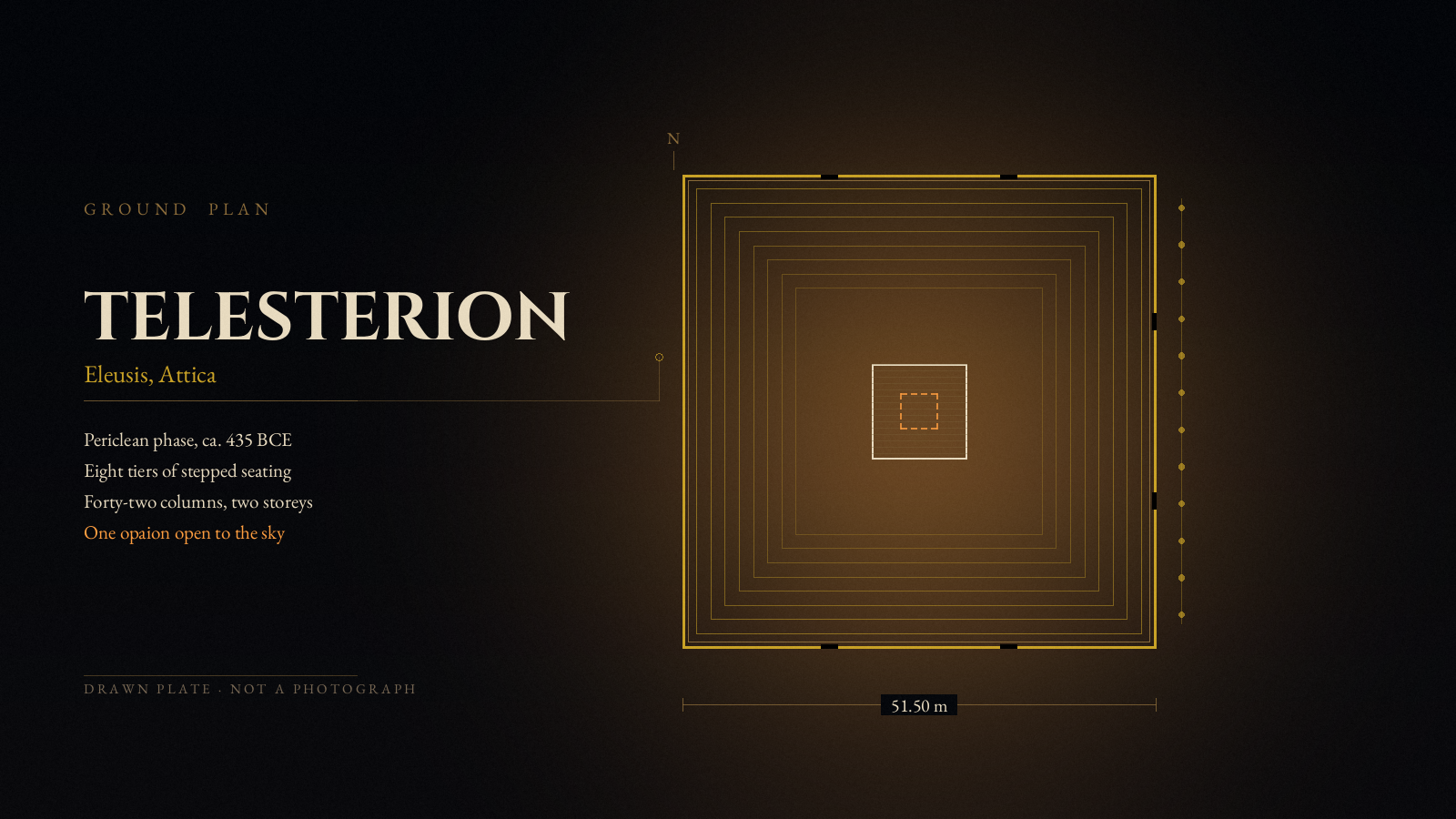
The hall itself was an instrument for producing a state. Almost square, fifty-one metres on a side, eight tiers of stepped seating on all four sides, forty-two columns carrying a second storey, and a single opening in the roof above a small central chamber. [2][3] Three thousand people on those tiers, in the dark, looking down and inward at a centre they could not properly see. Whatever happened in the middle of that floor, the architecture was doing most of the work.
Why the secrecy was not mystification
The modern instinct is to read the secrecy as branding. Keep the product behind a curtain, let rumour do the marketing, admit the initiates to a room and show them something mildly disappointing. We know this pattern well enough; it is how a certain kind of conference talk works.
But the ancient evidence does not support the branding reading, and one detail kills it: the exclusions were published. The herald announced, in the Agora, at the start of the festival, who was barred — those impure in hands, those who could not speak Greek. [4] That is not a marketing strategy. That is a specification. The institution told everyone exactly who could come, and then told nobody what would happen, and the two facts belong together: the qualification was public and the content was not, because the qualification was about whether the experience could land, and the content was the experience.
There is a general principle here that has nothing to do with religion. A sequence that is known in advance stops working. Not always, and not for everything: a recipe survives being read. But for any procedure whose effect depends on the participant not being able to get ahead of it — a test, a joke, a surprise, a grief, a difficult conversation you have rehearsed so many times that you can no longer have it — prior knowledge degrades the effect. The structure of the thing is temporal, and knowing the end collapses the middle.
Eleusis seems to have understood this at the level of institutional design. The initiates were told when to fast, when to walk, when to bathe, what to drink. They were not told what they would see. The sequence was administered like a protocol, and the withholding was part of the protocol, not a layer on top of it.
That is a very different thing from a secret. A secret is information someone has and you don't. A protocol is a procedure whose efficacy depends on your not having the ending. Conflating the two is the mistake that produces both the conspiracy theories and the debunkings, and both are boring in the same way.
What actually died in 396
In 392 the emperor Theodosius prohibited pagan cult, and Eunapius reports that the Mysteries were closed. In 396 Alaric's Goths came through Attica and the sanctuary was looted and burned. [5] The town never recovered.
Here is the part worth sitting with. When the institution died, what was lost?
Not the myth. We have the myth — the Homeric Hymn to Demeter is one of the best-preserved poems of Greek antiquity, and it tells the story of the abduction, the fast, the pomegranate seeds, the return. [6] Not the calendar: the month, the sequence of days, the procession route, the fee, the offices of hierophant and dadouchos are all reconstructable from inscriptions and lexica. Not the building: the foundations are there, and the plan is published.
What was lost was the thing the building was for. And that loss was not a gap in the record that a better archive could have filled. It was the success condition of the institution. Eleusis was designed so that the thing it transmitted would not survive in any medium except the people who had been through it. When the last of those people died, the transmission ended, exactly as designed.
There is a strange comfort in that and a real horror. The comfort is that the institution was not stupid; it did what it intended. The horror is that a thousand years of the highest religious prestige in the classical world produced, in the end, a hole in the record where the most important thing should be, and no amount of scholarship will ever fill it.
And here is the part that should worry us: the hole does not look like a hole. It looks like a subject. There are books about Eleusis, conferences about Eleusis, theories about Eleusis. The absence has generated more text than most presences ever do. If you did not know the difference between information and initiation, you would conclude from the volume of commentary that we know exactly what happened.
The archive's blind spot
We have built, in the last thirty years, the most complete copying machine in the history of the species. Anything that has been written down is on its way to being available everywhere, instantly, in any language, summarised at whatever length you prefer. This is genuinely extraordinary, and I do not want to be the person who pretends otherwise.
But the copying machine has a shape, and the shape is the shape of what was written down.
Consider what a really good model trained on the whole surviving corpus of antiquity knows about Eleusis. It knows the Hymn. It knows Pausanias's refusal — that his dream forbade him to describe the things within the wall. [7] It knows Clement's hostile transcription of the password: I fasted, I drank the kykeon, I took from the chest, having done my task I placed in the basket, and from the basket into the chest. [8] It knows Hippolytus's claim about the reaped ear of grain displayed in silence, and the cry of Brimo and Brimos. [9] It knows Plutarch's comparison of dying to initiation, with its wandering, its terror, and its sudden light. [10]
That is a great deal. It is also, precisely, the shell: the testimonia, the polemics, the fragments. The thing itself is not in there, and cannot be, because it was never in a medium. What the model has is the shadow the institution cast on the written record — and the shadow is real, and informative, and not the object.
Now the sharper problem. Ask that model what happened at Eleusis and it will answer. Fluently, at length, with citations. It will produce a plausible reconstruction, because that is what it is for: the objective rewards a confident completion of the pattern, and the pattern here is a hole surrounded by confident text about a hole. The system has no representation of "this is not recoverable" that is not itself a sentence it can generate. It cannot feel the difference between knowing and having the shape of knowing.
This is not a criticism of the models. It is a description of what any archive does when it is mistaken for the thing it archives. The library at Alexandria had exactly the same property: it contained everything, including the treatises on how to do things that no book can teach. We call the loss of the library a catastrophe because of the texts. The greater loss was probably the practitioners, and nobody wrote them down, because you cannot.
The counter-practice
If the diagnosis is that we have optimised for copy and let induction and initiation atrophy, then the response is not to abandon the archive. It is to notice which of the three you are doing, and to stop pretending that the first can substitute for the other two.
Three disciplines, in ascending order of difficulty.
Keep one thing you cannot look up. Choose a skill or a body of knowledge and refuse to outsource it to retrieval. Learn it to the point where it is in your hands, not in a note. The point is not nostalgia; it is calibration. Once you have one thing that lives in you rather than in a file, you can feel the difference between the two kinds of knowing, and you will stop accepting the substitute where it matters. For most people this used to be a musical instrument, a language, a trade, or a religious practice. It is now, for most people, nothing — and the absence is invisible until something goes wrong.
Submit to a sequence you did not design. Initiation, in the Eleusinian sense, required the participant to give up control of the order of events. You did not know what came next. Almost nothing in contemporary life asks this of anyone: we curate our own feeds, choose our own curricula, skip the parts that bore us, and call the result learning. A teacher, a form, a syllabus, a year of practice, a training programme with a gate at the end — anything where someone else decides the order and you cannot see around the corner — is the closest available analogue. It is uncomfortable in a specific way that is worth noticing, because the discomfort is the signature of a sequence that is actually doing something.
Make something that can fail in public. Copying is unfalsifiable: a text either matches or it doesn't, and the machine handles that. Initiation is falsifiable in a much harder sense: you find out whether the change took, because someone else can see whether you are different. Performance, teaching, publication, a difficult conversation you have been avoiding, a repair you attempt on a thing that matters — these produce evidence that no amount of reading produces. The evidence is often unflattering. That is the mechanism.
None of these is Eleusis. There is no reconstructing a mystery cult, and the attempt to manufacture one is one of the saddest genres of contemporary spirituality: the retreat with the smoke machine, the weekend workshop that promises transformation by Sunday, the guru with a subscription tier. They fail for the reason Eleusis succeeded. They are optimised for the experience of having been transformed, which is available immediately and cheaply, rather than for the transformation, which is slow, administered by someone else, and cannot be photographed.
What the empty hall is for
There is one line of Pausanias that I think about more than any other sentence in ancient travel writing. He has just described the temple of Triptolemus, the well where the women first danced, the threshing floor, the altar. He is a man who describes everything. And then:
My dream forbade the description of the things within the wall of the sanctuary, and the uninitiated are of course not permitted to learn that which they are prevented from seeing. [7]
He is not being coy, and he is not being paid to keep quiet. He is a professional sightseer who has been initiated, and the rule has held, and he is annoyed about it, and he says so. The refusal is the most informative sentence he writes, because it is evidence that the boundary was real — that a man whose entire literary personality is I will tell you what I saw stopped at a wall.
We do not have that wall any more, in any domain. Everything is describable, and the describers are now automated and inexhaustible. That is a genuine gain in almost every respect, and I would not trade it. But it has a cost that is easy to miss: when nothing is protected by silence, the silence stops being a signal. There is no longer any way to tell, from the outside, whether a thing is unsaid because it is trivial or because it cannot be said.
Eleusis is a reminder that the second category exists, that it was once the most important category, and that the institutions which housed it were not primitive. They were doing something we have largely stopped doing, and the thing they were doing is not available in a cheaper form.
The last thing Eleusis tells us is that its most important content was the only thing it could not say. The ear of wheat, shown in silence, if that report is even true — and it might not be — is not a secret doctrine. It is a demonstration of the limits of doctrine. One object, held up, in a room built for the purpose, after a year of preparation and a night of terror, and then nothing to write down.
You can call that a failure of record-keeping. The people who ran it for a thousand years would have called it the point.
FAQ
Did the Eleusinian Mysteries have a secret doctrine? Not in any form we can recover, and probably not in the sense the question assumes. Aristotle's fragment says the initiates underwent rather than learned. The only ancient claim about content — Hippolytus's reaped ear of grain shown in silence — is a single hostile testimony three centuries later. The evidence points to a designed experience rather than a body of teaching.
Why does it matter that the rite died? Because it is the clearest historical case of knowledge that existed only in the event of its transmission. The myth, the calendar, the building and the password all survive; the thing the building was for does not. That is not a gap in the record that better scholarship could fill — it is what the institution was designed to do.
Is this an argument against writing things down or against AI? No. It is an argument against treating the archive as the definition of what is real. Copying, induction and initiation are three different transmissions with three different success conditions. We have industrialised the first and let the other two atrophy, and the confusion is what produces both the overconfidence and the nostalgia.
What is the practical takeaway? Keep at least one thing you cannot look up, submit to at least one sequence you did not design, and make at least one thing that can fail in public. Those are the three cheapest available analogues to a transmission that is not a copy.
Sources
[1] Aristotle, fragment 15 Rose, preserved in Synesius, Dio 10: the initiates do not learn (mathein) but undergo (pathein) and are disposed in a certain way. Discussed in Walter Burkert, Ancient Mystery Cults (Cambridge, MA: Harvard University Press, 1987).
[2] Ephorate of Antiquities of West Attica, "Telesterion", Hellenic Ministry of Culture and Sports: 51.50 m side, eight tiers, forty-two columns, opaion, building phases.
[3] Perseus Digital Library, "Eleusis, Telesterion": c. 52 × 54 m, capacity up to 3,000, anaktoron beneath the opaion.
[4] For the prorrhesis — the proclamation barring those impure in hands or incomprehensible in speech — and the cost of initiation, see Ross Shepard Kraemer, ed., Women's Religions in the Greco-Roman World: A Sourcebook (Oxford University Press, 2004).
[5] Eunapius, Lives of the Philosophers and Sophists 7.3, on the closure under Theodosius and the destruction under Alaric in 396.
[6] Homeric Hymn to Demeter, trans. Hugh G. Evelyn-White (Loeb, 1914), Perseus Digital Library.
[7] Pausanias, Description of Greece 1.38.7, trans. W. H. S. Jones (Loeb, 1918).
[8] Clement of Alexandria, Protrepticus II.21.2, trans. Ante-Nicene Fathers, vol. 2 (1885).
[9] Hippolytus, Refutatio Omnium Haeresium V.8.39–40, trans. J. H. MacMahon, Ante-Nicene Fathers, vol. 5.
[10] Plutarch, fragment 178, preserved by Stobaeus, trans. A. O. Prickard (Oxford, 1918).
[11] R. Gordon Wasson, Albert Hofmann, and Carl A. P. Ruck, The Road to Eleusis (Harcourt Brace Jovanovich, 1978), for the entheogen hypothesis and its limits.
The historical reconstruction behind this essay — the building, the nine days, the grades, the politics of 415 BCE, and the end of the cult — is in the Vault of Arcana edition. For the transmission that was built entirely out of texts and nearly became a machine, read The Art of Memory; for the tradition that treats attention itself as the instrument, Vijnana Bhairava and the Technology of Attention.
To read the sources firsthand, the Library of Alexandria carries the classical and hermetic library in the shop, and the Ultimate Esoteric Archive collects the later commentaries.
The initiates did not learn a doctrine; they were put through a sequence. What survives is the shell — the hymns, the travel writing, the hostile transcriptions, the scholia that preserved the passwords. These archives hold that shell, and the thousand years of commentary built on top of it.