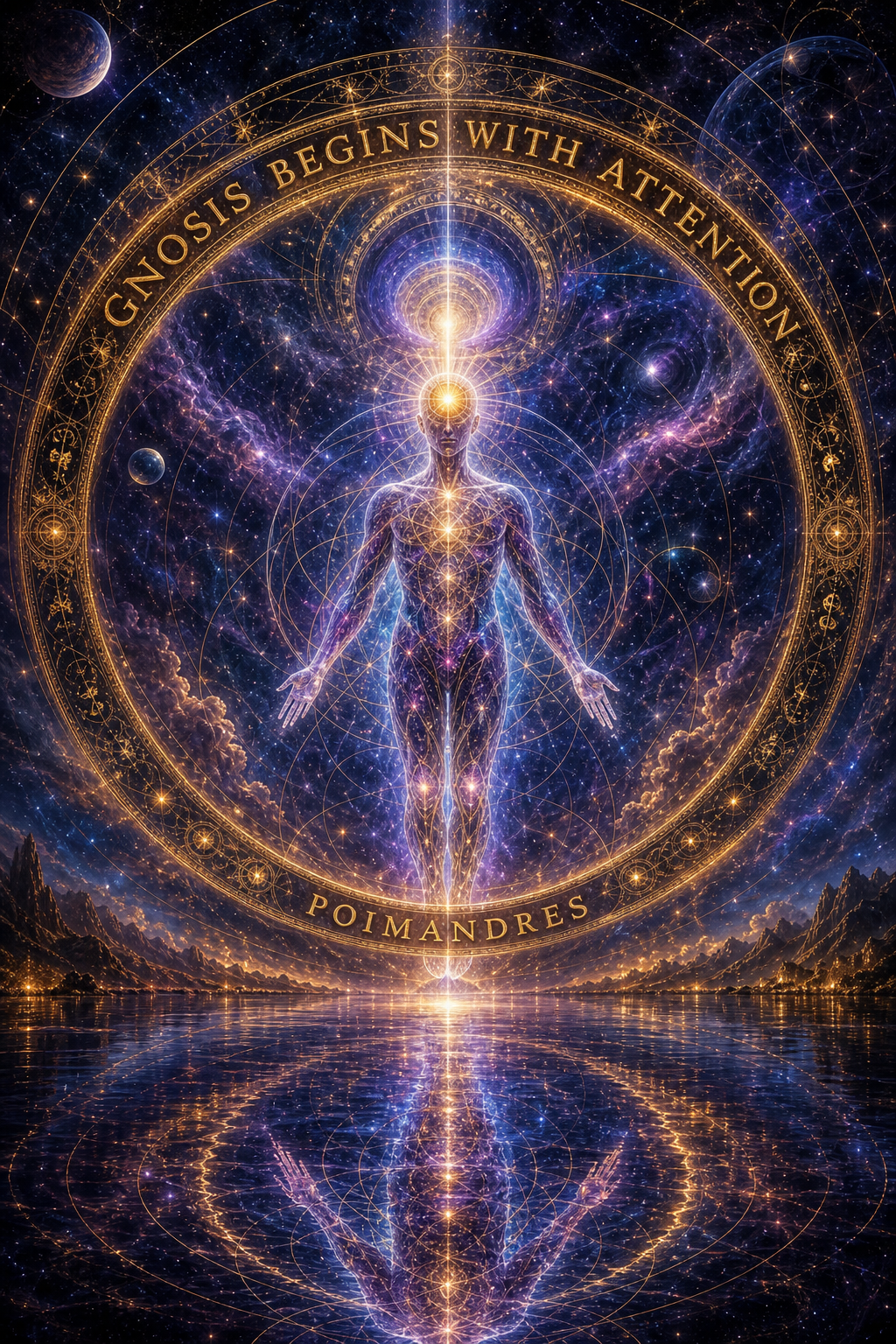
The Corpus Hermeticum does not treat gnosis as a secret fact that the mind can possess. In Poimandres and the Secret Sermon on the Mountain, awakening is a relocation of attention.
Layer 1: The Human Anchor
There is a modern fantasy of spiritual knowledge that looks very much like shopping. Somewhere, we imagine, there is a hidden diagram, a lost name, a perfect frequency, or an ancient sentence that will finally explain why experience feels divided. If we can find the right object of knowledge, the story goes, the self that is looking will remain exactly as it is — only better informed.
The Corpus Hermeticum begins somewhere more unsettling. Its first visionary dialogue does not open with a catalogue of secret facts. Hermes is asked what he wants to see, hear, understand, learn, and know. The answer is not delivered to a passive consumer. It arrives as a disturbance in the way he is able to perceive. Light appears, darkness condenses, a Word moves through Nature, and the one who asks the question is gradually made responsible for what his seeing has become.[1]
My thesis is simple: in the Corpus Hermeticum, gnosis is not the possession of an extraordinary idea but the disciplined relocation of attention. The cosmic human is not a superhuman who escapes the world. It is a person who can perceive body, psyche, Nature, and the intelligible order without reducing any one of them to the whole.
That claim places this essay beside, but not inside, the living traditions that have inherited the name “Hermetic.” The Corpus is a set of late-antique Greek dialogues attributed to the syncretic figure Hermes Trismegistus, not a single Egyptian manual written by one historical author. Its later Renaissance reception is also more complicated than the familiar story of a clean, uninterrupted “ancient wisdom” surviving intact. Wouter J. Hanegraaff has shown how much the Renaissance actually worked with a discourse about Hermes, translations, editions, and textual misunderstandings rather than with a transparent possession of an original tradition.[2]
If you want to read this argument against a larger primary-source background, the Hermetic source archive is the natural companion to this Scroll. The archive is not a substitute for a historical edition, a scholar, or a living teacher. It is a way to encounter the textual density that gets flattened when Hermeticism is reduced to a handful of slogans. What follows stays close to Poimandres and the Secret Sermon on the Mountain, and asks what their language of Mind, rebirth, silence, and the body can still do to a reader. Begin with the source-side Scroll on Vault of Arcana for the archive context that accompanies this transmission.
The Corpus Is Not One Ancient Book
The title Corpus Hermeticum can make the material sound more unified than it is. What we inherit is a collection of dialogues, sermons, revelations, and teachings that were gathered and transmitted in different ways. The figure who speaks through them is Hermes Trismegistus — “thrice-great Hermes” — a Hellenistic fusion of Greek Hermes and Egyptian Thoth. The historical texts emerge from the philosophical and religious ferment of the early centuries of the Common Era, in a world where Platonism, Egyptian religious language, Christianity, and movements later grouped under “Gnosticism” were in active conversation and conflict.[1]
That background matters because it changes the reader’s first question. Instead of asking, “What did the Egyptians secretly know?” we can ask, “What kind of transformation does this Greek-Egyptian dialogue imagine, and what does it require the reader to do?” The second question is less glamorous, but it is more faithful to the form of the texts. The Corpus does not present a systematic encyclopedia. It stages conversations in which a student misunderstands, a teacher withholds, a vision interrupts, and a word changes its meaning according to the level of perception at which it is heard.
The Renaissance added another layer. Marsilio Ficino’s Latin translation helped make Hermes central to European debates about primordial wisdom, magic, and the relation between pagan philosophy and Christianity. But Hanegraaff’s historical correction is essential: the editions circulating in that period were often corrupt, and Renaissance readers were not simply receiving an intact ancient message. They were constructing a Renaissance discourse about Hermes from incomplete and sometimes misleading textual witnesses.[2]
This is not a reason to discard the Corpus. It is a reason to read it without counterfeit certainty. The text is most valuable when it is allowed to remain a difficult late-antique conversation rather than turned into a universal vending machine for modern claims about quantum physics, simulation theory, or the neuroscience of meditation. For a useful contrast, compare this essay with the modern seven-principle system of the Kybalion. The Kybalion is a significant twentieth-century revival text, but it should not be quietly substituted for the older dialogues.
The distinction also protects the word gnosis. In these texts, gnosis is not merely information about invisible beings. It is a form of knowing that alters the knower. The question is not only whether a proposition is true. It is whether the person who repeats it has become capable of seeing what the proposition demands.
Poimandres: The Vision Begins with a Request to See
The first major dialogue is known by variant spellings: Poimandres, Poemandres, or Pimander. In the public English edition used for the primary quotations here, the encounter begins with Hermes “in deep thought concerning things that are,” when an immense figure calls him by name and asks what he wishes “to Hear and See,” what he would “Understand, to Learn, and Know.”[1]
That sequence is already a map. Seeing is not separated from hearing; understanding is not separated from learning; knowing is not detached from the condition of the one who wants to know. Hermes does not ask for a technique or an answer to a practical problem. He asks to understand what is real, to understand Nature, and to know God. The request is total, and therefore the answer cannot be a single piece of content.
Poimandres identifies himself as “the mind of the Great Lord,” always present with Hermes. The phrase is easy to sentimentalize into a private guardian angel, but the scene is stranger than that. The figure is not merely a comforting inner voice. He is an encounter with a scale of Mind that makes Hermes’ ordinary scale of mind look partial. Poimandres says, in effect, that the teacher is present wherever the desire to know is actually examined — but presence is not the same as possession.
The vision then unfolds through contrasts: light, darkness, a moist and troubled Nature, fire, air, earth, water, and the Word that moves among them. The text is not offering a physics diagram in antique clothing. Its cosmology is a grammar of attention. Forms become visible according to the relation between the perceiver, the Word, and the world perceived.
At the center of the revelation, Poimandres says:
“That which in thee Seeth and Heareth, the Word of the Lord, and the Mind, the Father, God, Differeth not One from the Other, and the Unison of these is Life.” [1]
This is not the same as saying that every thought in a human head is divine. The distinction is crucial. The text points to “that which in thee Seeth and Heareth,” not to every opinion, fantasy, or self-image that happens to pass through consciousness. Mind is identified through a capacity for awakened seeing and hearing — a capacity that must be discovered, trained, and ethically clarified.
Poimandres immediately follows the revelation with an instruction: “conceive well the Light in thy mind and know it.”[1] The Light is not a collectible object placed inside an already finished self. To know it is to allow the organ of knowing to be reorganized. The reader is not told to accumulate more images. The reader is told to examine the activity by which images become convincing.
This is why the opening vision is more psychologically exact than a summary such as “everything is consciousness.” It asks what happens when attention stops treating the world as a warehouse of separate objects. The elements do not disappear. They become legible within a living order. The human being does not become the owner of that order. The human being becomes answerable to it.
The Cosmic Human Is a Double Exposure
The Corpus often describes the human being as double: mortal in body, yet connected to an immortal or intelligible dimension. Modern readers can turn this into a crude escape fantasy — spirit good, body bad, earth a prison, death a promotion. The dialogues themselves resist that simplification.
In Poimandres, the human enters the ordered cosmos, learns the nature of the spheres, and becomes subject to fate and bodily change. The human is powerful enough to participate in the cosmic order and vulnerable enough to become its servant. That tension is not a mistake to be solved by choosing one side. It is the condition of human attention. We are capable of seeing patterns larger than our immediate appetite, but we are also embodied creatures whose perception is shaped by hunger, fear, desire, memory, and time.
The cosmic human is therefore a double exposure. One image is the finite organism: measurable, changing, born into a world of sensation and consequence. The other is the capacity to perceive the whole relation in which that organism exists. The second image does not cancel the first. It gives the first a context.
The most revealing moment in the later Secret Sermon on the Mountain is not a command to hate the body. It is a warning about confusing a bodily viewpoint with the whole of reality. Tat eventually says that he sees the All and himself in Mind. Hermes names this Rebirth: “no more to look on things from body’s view-point,” while immediately adding that this is not a reason to become a slanderer of the All.[1]
The qualification is decisive. A spiritual interpretation that makes the universe contemptible has misunderstood the text. The body’s viewpoint is limited; it is not worthless. Sensation is not the enemy. The problem is the claim that whatever can be reduced to sensation, measurement, possession, or fear is all that exists.
This also explains why the cosmic human should not be confused with the “chosen individual” of modern fantasy. The person who sees more clearly is not granted permission to dominate more completely. In the Corpus, knowledge creates a responsibility to the order of life. The human is a microcosmic participant, not a sovereign proprietor.
For a later, practical cousin of this idea, the Picatrix and its technology of correspondence is a useful comparison. The Picatrix asks how image, time, material, speech, and attention can be brought into relation. The Corpus reaches further inward: before a person can align the world, the person must notice the kind of seeing that is doing the aligning.
Rebirth Is a Change in the Viewpoint
The thirteenth tractate, often titled “The Secret Sermon on the Mountain” or “The Secret Sermon on Rebirth,” gives the essay its central evidence. Tat asks Hermes what substance, womb, or seed produces the new human. This is an ordinary mistake in spiritual language: he assumes transformation must be a thing with a material cause that can be located and possessed.
Hermes answers in a way that frustrates the demand for a mechanism. Wisdom understands in silence; the True Good is the seed; the Will of God is the sower. When Tat asks what kind of person is born, Hermes says that the race is not taught in the usual way. Its memory is restored by God.[1]
The passage becomes more precise when Hermes describes the change in the first person:
“Whene’er I see within myself the Simple Vision brought to birth out of God’s mercy, I have passed through myself into a Body that can never die. And now I am not as I was before; but I am born in Mind.” [1]
The phrase “born in Mind” is easy to turn into a promise of supernatural status. In context, it describes a break in identification. Hermes is not claiming that his ordinary personality has acquired an impressive new label. He says, “I am not as I was before.” The old way of locating the self has been interrupted.
The passage then refuses ordinary visual proof. The new condition “is not taught” and cannot be seen by the compounded element through which the student normally sees. Tat looks at Hermes with bodily sight and still cannot understand what Hermes is. The lesson is not that the body is stupid. It is that each instrument reveals some things and hides others. A ruler is not a bad tool because it cannot hear music.
The text next names twelve “Tormentors” that move through the prison of the body: Not-knowing, Grief, Intemperance, Desire, Unrighteousness, Avarice, Error, Envy, Guile, Anger, Rashness, and Malice. These are not best read as a universal clinical taxonomy or as a literal set of entities waiting to be exorcised. They are a dramatic account of the forces that make attention contract around the self’s immediate defenses.
The first torment is Not-knowing — not an innocent absence of facts, but a condition in which the person cannot recognize the limits of their own frame. Avarice narrows the field to acquisition. Envy makes another person’s radiance feel like a personal diminishment. Anger turns a complex situation into a simple enemy. The list is a psychology of attention because each torment changes what can be seen.
The antidote is not a new collection of superior labels. The dialogue introduces ten Powers that gradually displace the twelve Tormentors. Self-control, sharing, truth, and related powers are presented as conditions through which attention becomes less possessed by its reflexes. The architecture is symbolic, but its operation is concrete: the mind sees differently when it is not being driven by the same appetite at every moment.
Hermes then says:
“Gnosis of God hath come to us, and when this comes, my son, Not-knowing is cast out.” [1]
Notice the grammar. Gnosis “comes”; it is not manufactured as an ego achievement. Yet it also requires room. The student must become silent, still, and receptive enough for a different order of knowing to appear. Gnosis is grace and discipline at once — not because the text offers a neat compromise, but because it refuses to separate transformation from the conditions that make transformation possible.
Later, Tat says that he no longer sees with the ordinary sight of his eyes, but with the energy Mind gives through the Powers. He then declares himself present in heaven, earth, water, air, animals, plants, and the womb — “everywhere.”[1] This is not a modern claim of omnipresence made by the ego. It is a poetic collapse of the isolating viewpoint. Tat is no longer imagining himself as a spectator located outside the world, trying to acquire a vision of the world.
Then comes the sentence that should govern every reading of Hermetic rebirth:
“Father, I see the All, I see myself in Mind.”
“This is, my son, Rebirth — no more to look on things from body’s view-point … in order that we may not be calumniators of the All.” [1]
The old self is not replaced by a grander self-image. The viewpoint changes. Body remains; what changes is the claim that the body’s limited perspective exhausts reality. Mind becomes a field in which self and All can be seen together.
This is why the title of the present essay says that gnosis begins as a change in attention. The phrase is not a modernization meant to make the Corpus sound like cognitive science. It is a disciplined paraphrase of the dialogue’s repeated concern with seeing, hearing, silence, bodily viewpoint, Mind, and the Powers that alter what the student can perceive.
What the Profession of Silence Actually Does
The Secret Sermon repeatedly asks Tat to be still. The hymn of rebirth is “not taught,” but kept hidden in silence. A modern reader may hear this as elitism: the teacher is withholding the secret. There is some secrecy in the text, but the deeper function of silence is epistemic. Silence interrupts the mind’s habit of converting every encounter into property.
When we speak too quickly, we often turn a living perception into a position. We name it, defend it, sell it, and use it to stabilize an identity. The Hermetic dialogue does not reject words — it is made of words, and it calls the Word creative. It distinguishes between language that opens perception and language that closes the case.
Silence is therefore not mute passivity. It is a temporary suspension of ownership. The student stays with the question before turning it into a slogan. This is why Hermes can say that the teaching is not merely delivered by speech. The point is not to deprive the student of information. The point is to prevent information from becoming another object around which the old self can organize its pride.
The sequence from Not-knowing to Gnosis also gives silence an ethical dimension. If the mind is filled with grief, anger, envy, or avarice, a new metaphysical statement will usually be recruited to serve the old pattern. A person can say “All is Mind” while remaining unable to see another person except as an obstacle or an instrument. The Corpus would call that a failure of rebirth, not a successful intellectual ascent.
A contemporary reader can test the passage without pretending to recreate an ancient initiation. Sit with one question that you cannot solve by collecting another explanation. Notice the impulse to turn the question into a performance. Notice what the body is doing — tightening, fleeing, reaching, rehearsing. Then let the question remain present without asking it to certify who you are.
That is not a magical guarantee, and it is not a substitute for mental-health care, religious community, or a teacher within a tradition. It is simply a way of allowing the text’s own demand to become perceptible: before knowledge changes the world, it changes the relation between the knower and what is being known.
Three Misreadings of Hermetic Mind
1. “The universe is mental, so modern physics proves Hermeticism.”
The Corpus uses Mind, Light, Word, Life, and Nature within a late-antique theological cosmology. It does not describe quantum fields, digital simulation, or information theory. The resemblance between ancient metaphysical language and modern scientific metaphors can be philosophically interesting, but resemblance is not confirmation.
The Kybalion’s “All is Mind” is a later formulation with its own historical setting. Reading it beside the Corpus can produce a productive comparison; treating it as a quotation from Hermes is a category error. A text becomes more interesting, not less, when we stop making it win arguments it never entered.
2. “Hermeticism is simply the secret religion of ancient Egypt.”
The Egyptian presence is real, but “simply” is doing too much work. Hermes Trismegistus is a syncretic figure, and the surviving dialogues are Greek texts shaped by the intellectual world of Hellenistic and Roman Egypt. Their language bears the marks of Platonism, Egyptian religious imagination, Jewish and Christian scriptural resonance, and other currents of the late antique Mediterranean.[1]
Hanegraaff’s account of Renaissance reception makes the same caution necessary in another direction. There is no single pure chain from an Egyptian temple to every modern book that uses the word Hermetic.[2] The tradition is a history of texts, translations, reinventions, and arguments — a living archive, not a sealed capsule.
3. “Rebirth means escaping the body.”
The Secret Sermon does use the language of leaving bodily senses behind, and it calls the natural body mortal. But Hermes also warns against becoming a calumniator of the All. The goal is not contempt for embodied existence. It is freedom from treating the body’s finite viewpoint as the final measure of reality.
A person who hates the world may still be completely possessed by it. The Corpus’s more difficult demand is to inhabit the world without allowing desire, fear, status, and sensation to become the only authorities. Rebirth is not an exit route from responsibility. It is a new way of seeing the field in which responsibility occurs.
A Practice of Reading the Cosmic Human
The Corpus Hermeticum is not a self-help manual, and the following exercise is not an ancient rite reconstructed from a website. It is a modern reading practice designed to keep the text’s thesis honest.
First: locate the object of your attention. What are you trying to obtain — certainty, recognition, control, relief, a spiritual identity? Name the object without shaming yourself. In Poimandres, the request to see and know begins the vision, but the desire to know must eventually become visible to itself.
Second: locate the frame. What does your current viewpoint make easy to see, and what does it make impossible to notice? Anger may reveal injustice while hiding vulnerability. Desire may reveal aliveness while hiding compulsion. Fear may reveal danger while hiding possibility. The point is not to flatten these distinctions into “everything is an illusion.” The point is to see the power and limit of the frame.
Third: widen the field without abandoning the body. Notice the body as an instrument of perception: breath, tension, temperature, posture, fatigue. Then notice the relations around it: other people, language, place, memory, material conditions, consequences. “I see myself in Mind” does not mean “I stop being embodied.” It means “I stop pretending that the isolated body is the whole scene.”
Fourth: relinquish ownership of the insight. If a clear perception appears, let it remain clear without turning it into a new costume. The Corpus’s silence protects a fragile recognition from being immediately converted into authority. Gnosis that makes a person more boastful has probably been captured by one of the old Tormentors.
The value of this practice is not that it makes a reader immortal. The primary text itself uses mythic language that should not be translated into a medical promise. Its value is that it reveals how quickly “spiritual knowledge” becomes another form of acquisition. The cosmic human is not the person with the most impressive inner biography. It is the person whose attention has become spacious enough to include the reality that does not flatter it.
Why This Old Dialogue Still Matters
The contemporary crisis of attention is usually described as a problem of distraction: too many alerts, too much content, too little quiet. The Hermetic diagnosis is more severe. The problem is not only that attention is captured from the outside. It is that we often want to be captured by whatever confirms the self we are trying to preserve.
The Corpus offers a different model of knowledge. Information is not the enemy, but information alone cannot produce the transformation the dialogues describe. A person can possess a library of symbols and remain trapped inside the same twelve reactions. A person can know every name for Mind and never ask what in them is actually seeing and hearing.
This is the reason the text’s cosmology should be read as an ethical cosmology. The universe is not a backdrop for an exceptional self. It is the larger order within which the self becomes answerable. Light, Nature, body, Word, fate, and Mind are not merely decorative pieces of an antique map. They are ways of asking what kind of person can perceive a world without turning it into a possession.
In that sense, the Corpus Hermeticum belongs in conversation with any archive that treats consciousness as a living problem rather than a brand identity. The Universal Transmissions archive offers a wider contemporary field of consciousness, symbolism, and transmission; the Hermetic dialogues contribute one severe question to that field: what must change in the knower before knowledge can become life?
FAQ: The Corpus Hermeticum and Hermetic Gnosis
What is the Corpus Hermeticum?
The Corpus Hermeticum is a collection of Greek philosophical and religious dialogues attributed to Hermes Trismegistus, the syncretic figure associated with Greek Hermes and Egyptian Thoth. The texts emerged from the intellectual and religious world of late antiquity and were later translated, edited, and reinterpreted in Renaissance Europe.[1][2]
What is Poimandres?
Poimandres — also spelled Poemandres or Pimander in English editions — is the visionary opening dialogue of the Corpus Hermeticum. Hermes encounters a vast figure identified with universal Mind and receives a revelation about Light, Darkness, Nature, Word, cosmic order, and the human being’s double condition as mortal and connected to the intelligible.[1]
What does Hermetic “rebirth” mean?
In the Secret Sermon on the Mountain, rebirth is an intellectual and spiritual transformation in which the student no longer sees reality only from the body’s limited viewpoint. It is described as being “born in Mind,” but the dialogue also warns against slandering or despising the All. The teaching is about a transformation of perception and identification, not a medical claim that the physical body becomes immortal.[1]
Is Hermeticism the same as Gnosticism?
No. Hermetic and Gnostic texts share themes such as divine knowledge, light, ignorance, cosmic intermediaries, and the transformation of the human being, but they are not one identical tradition. “Gnosticism” is itself a broad modern category covering diverse ancient movements. The safest approach is to compare specific texts rather than collapse them into a single universal system.
Does “Mind” in the Corpus Hermeticum mean the human brain?
Not in the modern neuroscientific sense. The Greek concept usually translated as Nous refers to an intellective or divine mode of knowing within a larger metaphysical cosmology. The Corpus sometimes speaks of the mind present in the human being, but it does not reduce that Mind to the brain or present a scientific theory of consciousness.
Closing: The Mind That Learns to See
The first movement of Hermetic gnosis is not upward. It is inward enough to discover what is doing the looking.
Hermes asks to know what is real. Poimandres answers with a vision that rearranges the relation between Light, Nature, Word, and the human witness. Tat asks how rebirth is made. Hermes refuses to give him a substance he can own and instead describes a change in which he is no longer what he was before. The student finally says, “I see the All, I see myself in Mind.”
The sentence is not an invitation to inflate the self until it becomes cosmic. It is an invitation to let the isolated self become permeable to the order it depends upon. Body remains. Nature remains. The world remains difficult. What changes is the claim that the old viewpoint was the whole of reality.
That is why the Corpus Hermeticum still has a pulse beneath its archaic language. It does not ask us to collect another identity called “initiated.” It asks whether attention can become honest enough to see its own Tormentors, silent enough not to possess every insight, and spacious enough to include the All without calumniating it.
The hidden teaching is not a secret object. It is the moment the knower becomes different from the person who wanted to own knowledge.
Sources
[1] https://archive.org/details/the-corpus-hermeticum-hermes-trismegistus-g.-r.-s.-mead — Hermes Trismegistus, The Corpus Hermeticum, G. R. S. Mead translation; the public OCR text includes “Poemandres” and “The Secret Sermon on the Mountain.” Quotations in this essay follow this edition, with minor punctuation normalization.
[2] https://dare.uva.nl/id/e2747377-d280-4eb7-98a8-f611e9a77ea6 — Wouter J. Hanegraaff, “How Hermetic was Renaissance Hermetism?”, Aries 15.2 (2015), pp. 179–209; open-access record and abstract.
[3] https://doi.org/10.1163/15700593-01502001 — DOI record for Hanegraaff’s article, “How Hermetic was Renaissance Hermetism?”
[4] https://archive.org/details/eight-tractates-v2-print — C. S. Myatt, The Corpus Hermeticum: Eight Tractates, a publicly accessible parallel translation useful for comparing wording and interpretive choices.
Continue the Study in the Vault
This transmission opens onto a larger primary-source study. Continue with the relevant Vault archives:
Carry the Poimandres reading into the wider Hermetic source tradition — rare texts, alchemical manuscripts, and the primary material behind the correspondence.
OPEN THE HERMETIC ARCHIVE →